
In recent years, competition in the fitness industry has gradually shifted from floor area efficiency and the number of machines to operational efficiency, service consistency and risk control. On one hand, large chain brands are accelerating expansion while small community gyms are emerging, making distributed, multi-site operations the norm. On the other hand, consumers’ expectations for real-time feedback, personalized training and safety assurance are rising rapidly. The health and fitness market is returning to a growth trajectory, and technological innovation together with digital experiences has become a core approach for operators to redefine member value.
The real challenge, however, lies in the fact that gyms are highly on-site, service-centric businesses. As the business model moves toward 24/7 access, unmanned night operations and cross-branch sharing of coaching resources, operators are confronted with three categories of pain points.
The first is inconsistent service quality. During peak hours, coaches struggle to cover every member’s movement quality; during off-peak or late-night hours, members are more likely to train without any guidance. This gap ultimately reflects in member stickiness and renewal rates.
The second is safety risk and liability. Deviations in posture during free-weight training, complex compound movements, accumulated fatigue and improper equipment operation can all lead to strains, sprains or falls. Training injuries are correlated with many factors, including training methods, individual conditions and environment, which makes it critical to establish real-time monitoring and traceable management mechanisms without significantly increasing manpower.
The third is system operations and maintenance. In a multi-camera, multi-site, multi-software-version environment, if operators still rely on traditional on-site repairs and manual inspections, the 24/7 service promise can easily become an amplifier of maintenance cost and complexity.
Against this backdrop, what makes edge AI particularly suitable for 24/7 gyms is not merely “bringing AI to the site,” but pulling decision-making and feedback from the cloud back to where the cameras and equipment are. With lower latency and better protection of member privacy, edge AI supports two scenarios with the highest business value: AI coaching (real-time motion feedback and training assistance) and safety monitoring during equipment usage (safety surveillance and event alerts). When these two scenarios are systematized, quantified and replicated across multiple sites, gyms can truly achieve scalable operations that are “lean in manpower and non-stop in service.”
What really shapes member experience is not whether AI can recognize movements, but whether the feedback is real-time, consistent and seamlessly integrated into the training flow. This directly reflects users’ growing acceptance of personalized guidance and has become a key differentiator in gym services.
A common implementation is to install cameras and displays in equipment areas, with edge nodes performing local pose estimation and motion analysis. The screen presents the current movement status, critical joint angle deviations and suggested adjustments, and can trigger sound prompts or push notifications when necessary. Because inferencing is completed locally, latency and frame stuttering risks are more controllable, which is especially critical for applications that rely on real-time feedback.
Here, the focus is on detecting risk indicators and shortening response time. Instead of judging from a single frame, edge AI evaluates continuous motion sequences to determine anomalies, such as unstable mounting or dismounting of equipment, fall-like postures in free-weight areas or users remaining on the floor for an abnormally long period. Once the system identifies an anomaly, it can trigger alarms on-site and simultaneously push event notifications to mobile phones or the control room. Event timestamps and camera sources are logged to the server to form a traceable record.
Under a 24/7 operating model, the largest hidden cost is often maintenance. Allxon’s out-of-band (OOB) technology covers remote power control, support for multiple network types, cloud-based serial console, over-the-air (OTA) capabilities and extensions for environmental sensing.
For gyms, if an edge node in a certain area fails during late-night hours, administrators can first attempt a remote power cycling. If system access permission issues occur, they can troubleshoot via Allxon Cloud Serial Console. During multi-site deployment, a single unified portal can be used to perform firmware/software updates, configuration backups and rapid provisioning. The joint solution from Portwell and Allxon integrates high-performance edge AI hardware with OOB remote operations, enabling enterprises to keep devices running reliably in remote or unmanned environments, reduce on-site interventions and enhance management efficiency.
Allxon, a leading provider in Edge AI Device Management, providing an efficient and open device management SaaS platform to Empower Business Solutions. Collaborating with global independent hardware vendors (IHVs) and software vendors (ISVs), Allxon delivers cutting-edge solutions for key system integrators (SIs) and managed service providers (MSPs). Pioneering first-in-market Out-Of-Band (OOB) Technology to minimize business downtime with innovative disaster recovery solutions, Allxon is an NVIDIA Jetson ecosystem cloud service partner and a preferred third-party fleet management partner for NVIDIA Metropolis Microservices for Jetson in Taiwan.
From an industry perspective, this type of project is essentially a classic architecture of distributed AI inference combined with centralized operations management. On site, multiple video streams serve as the primary sensing input. Edge AI systems perform pose estimation, motion tracking, state determination and event classification, then send the results, rather than raw video, to the management side for alerting, logging and multi-site operational analysis.
This design significantly reduces the long-term cost and latency of cloud video streaming. It also facilitates layered privacy strategies; for instance, executing de-identification on the edge and only uploading motion features and event clip indices, enabling operators to strike a controllable balance between usability and regulatory compliance.
In a typical deployment, multiple cameras feed video into an inference node. The inference node executes a three-stage pipeline: “motion tracking → motion analysis → analysis result (normal/abnormal)”, and outputs the results to a user status display. At the same time, the system triggers alerts and push notifications to inform managers or on-duty staff of events in real time.
On the hardware side, Portwell PJAI edge AI inference systems offer tiered computing performance to meet the needs of gyms of different scales:
The PJAI-200 is powered by an NVIDIA Jetson AGX Orin, delivering up to 200 TOPS of AI performance and equipped with 32GB LPDDR5 memory. It offers rich I/O interfaces, including 12-port PoE GbE, 10GbE and eight USB 3.2 Type-A ports, making it ideal for applications that integrate multiple cameras and sensors.
For gyms, this I/O configuration means a single edge AI system can simultaneously connect multiple video streams from free-weight zones, functional training areas and cardio sections. PoE simplifies cabling and power management, which is particularly advantageous for rapid new-site rollouts or retrofits of existing branches.
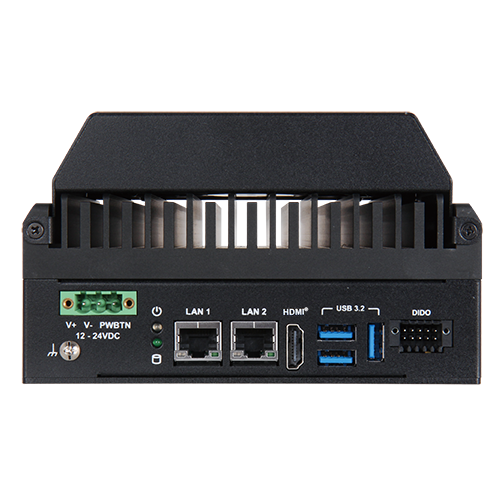
The PJAI-1100F and PJAI-1100 offer more compact options. The PJAI-1100F adopts NVIDIA Jetson Orin NX in Super Mode (up to 157 TOPS) and provides 2x GbE, USB 3.2 Type-A/Type-C, HDMI® 2.0b, 2x COM (RS-232/422/485), CANbus FD, 8-bit DIO, M.2 expansion and 12–24V terminal-block power input. It is well suited for deployment directly beside equipment to perform real-time inference and control integration.
For environments that require silent, fanless operation, such as locations with more dust and fibers, the PJAI-1100 offers a fanless design with a similar I/O set and wide-temperature support. This makes it suitable for installation in low-voltage cabinets, equipment racks or concealed wall-mounted locations.
When 24/7 gyms aim to replicate an edge AI–driven operating model across multiple locations, the most critical success factor is managing a myriad of details. The value of DMS (Design and Manufacturing Services) extends far beyond hardware specifications. DMS covers an end-to-end process: requirement definition, hardware and firmware design, validation, thermal and reliability testing, ramp-to-mass-production and after-sales maintenance. This integrated flow enables operators to achieve shorter deployment cycles, more stable supply, more consistent cross-site experiences and more predictable maintenance costs.
For “video + AI + 24/7 operations” scenarios, DMS services can tailor designs to gym-specific cabling layouts and installation constraints. Security and OOB management components can be pre-installed and configured before shipment, allowing devices to approach a near zero-touch provisioning experience upon arrival at each site.
As a result, customers receive not just hardware, but a scalable and continuously evolving management model. With fewer on-site personnel, they can still maintain a highly available smart operations foundation. AI coaching and safety monitoring become standardized services and auditable processes, turning the 24/7 operating model itself into a key competitive advantage.