The retail industry is facing pressure from two directions at once: on one hand, consumers expect instant availability and a smoother shopping journey; on the other hand, operations are constrained by labor shortages, rapidly expanding assortments and increasingly complex cross-store management. In practice, the truly critical in-store data comes far more from images and behaviors than from traditional reports. As a result, placing AI inference at the edge, in the store itself, has gradually become the mainstream approach. This architecture reduces latency, lowers bandwidth costs associated with streaming video back to the cloud and, through localized processing, makes it easier to reduce privacy risks.
For smart retail to scale, success depends on more than just system compute performance. The key question is whether the entire chain, “image capture → on-site inference → event output → system integration”, can be closed at the store level and then replicated consistently across locations on a unified platform. Smart shelves and people flow monitoring may look like different applications, but they actually share the same technical backbone: multiple video streams feed into an edge node, AI models output structured events, and these are then integrated with store management systems and cloud dashboards.
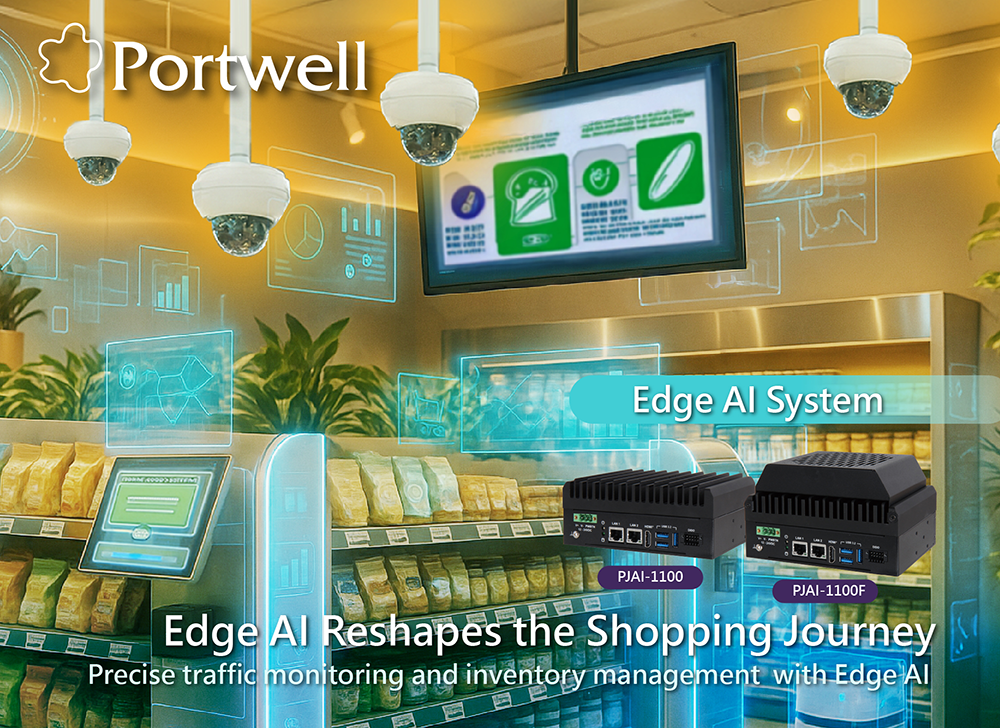
In smart retail environments, edge AI systems must simultaneously support multi-channel video streaming, low-latency inference, network isolation between internal and external domains, and optional wireless or cellular backup connectivity. The PJAI-1100F and PJAI-1100 are built around NVIDIA Jetson Orin modules, delivering the network and peripheral interfaces commonly required in retail. Within the product family, the PJAI-1100 targets fanless, maintenance-free deployments, while the PJAI-1100F adopts active cooling to support higher loads and performance output. Official specifications note support for Orin NX Super Mode with up to 157 TOPS of AI compute, making it suitable for more complex vision workloads.
The core value of smart shelves lies in transforming shelf status into replenishment and merchandising tasks. With fixed-view cameras, edge AI models perform on-device recognition of product status and output structured status messages to in-store systems or the cloud, enabling replenishment workflows to shift from manual patrols to system-triggered actions. This vision-driven approach, improving shelf utilization while reducing manual stock checks and inspection efforts, has already been recognized as a key path toward retail digitalization and intelligence.
What stores truly need are critical metrics: visitor counts, dwell time in specific areas, congestion and queuing trends, and peak-time staffing insights. By performing anonymized statistical analysis at the edge, the system helps alleviate privacy concerns while improving real-time responsiveness. With this architecture, people flow analytics become an operational tool, not just a reporting function, directly supporting decisions about staffing, service quality and layout optimization.
For a smart retail edge AI platform, the real differentiator is the ability to deliver compute, connectivity, reliability and maintainability as a complete package. The PJAI-1100F adopts Jetson Orin NX combined with LPDDR5 and NVMe (M.2 Key-M, PCIe x4) as the foundation for inference and local data caching. Across the PJAI-1100 series, scalable options from Orin Nano to Orin NX allow the same hardware family to be configured for different cost-versus-performance requirements, while maintaining a unified software stack and operational process.
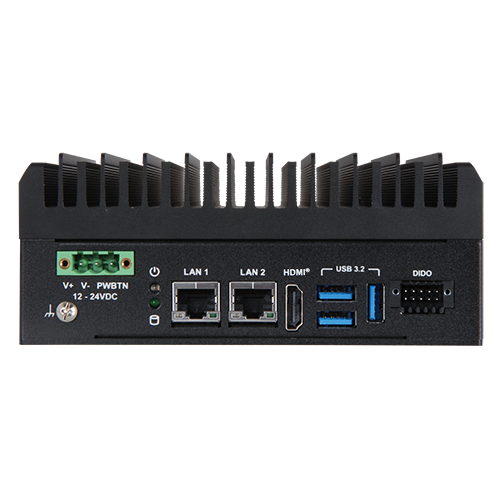
In real deployment, integration quality often determines the overall experience. Smart shelf solutions may need to connect barcode scanners or I/O indicators, while people flow monitoring may require displays or integration with legacy devices. The PJAI-1100F/PJAI-1100 provide 2x GbE, USB 3.2, USB-C, HDMI® 2.0b, DB9 serial ports, CANbus and 8-bit DIO, covering typical integration needs for cameras, switches, displays and I/O peripherals in retail environments.
From a reliability and deployment standpoint, common in-store installation locations such as weak-current cabinets, under-counter spaces and dusty or thermally challenging areas put thermal and power design to the test. The PJAI-1100F supports an operating temperature range of -20°C to 60°C and 12–24V terminal block power input, making it suitable for high-load inference tasks. The fanless PJAI-1100, in turn, is better aligned with maintenance-free expectations and offers flexible mounting options.
Taken together, these capabilities complete a more robust value chain after deployment: smart shelves shorten the time from out-of-stock occurrence to replenishment and improve shelf utilization, while people flow monitoring provides data-driven insights into customer movement and service efficiency. Combined, they give stores the ability to react in real time, aligning operational adjustments with what is happening “now” rather than relying solely on post-hoc reviews.
Design and Manufacturing Services (DMS) standardize design, validation, mass production, supply and after-sales maintenance into a unified process. A mature DMS provider proactively mitigates the risks that retail customers worry about most. This includes thermal and mechanical design margins for weak-current cabinets and high-temperature environments, compatibility testing for terminal-block power and peripherals, and pre-loading software and security settings before shipment to bring devices as close as possible to “zero-touch” deployment. At the same time, long-term supply strategies help avoid forced redesigns caused by component EOL or supply fluctuations, which can degrade end-user experience and increase maintenance costs.
For smart retail service operators, this translates into shorter deployment lead times, more consistent collaboration experiences and predictable total cost of ownership over the entire life cycle. For system integrators and solution providers, it means reusing the same engagement model to replicate projects quickly and reduce customization friction, ultimately turning on-site applications into a scalable retail operations engine.