In recent years, driven by smart manufacturing initiatives and decarbonization pressure, global manufacturers have been accelerating the upgrade of traditional PLC/SCADA architectures to a hybrid “edge computing + cloud platform” model. On the shop floor, the diversity of equipment continues to expand. In addition to existing PLCs, sensors, and motor drives, new device types such as industrial cameras, collaborative robots, AGV/AMR, and smart jigs are being introduced, leading to an explosive growth in data sources.
For production environments, the key challenge is how to complete fast computation and decision-making directly at the machine or line node, instead of sending all data back to the cloud or a centralized server, which can cause latency and bandwidth bottlenecks.
At the same time, the requirements for real-time responsiveness and precision in control loops continue to rise. In applications such as high-speed packaging lines, SMT placement, visual inspection, or multi-axis motion control, even slight latency may cause yield loss or mechanical collisions. Furthermore, most control cabinets on the line are extremely space-constrained, so manufacturers often face the dilemma of wanting to add more computing functionality but not having enough physical space.
In response to the trend of equipment miniaturization and modularization, more and more machines want to embed the controller directly inside the mechanical structure. This drives the demand for embedded boards with highly integrated I/O, low power consumption, wide-range DC input, and long-term product availability. Security is another critical pain point: once an edge node is attacked, it may not only halt production but also become an entry point into the enterprise OT/IT network. As a result, hardware-level security mechanisms have become essential selection criteria.
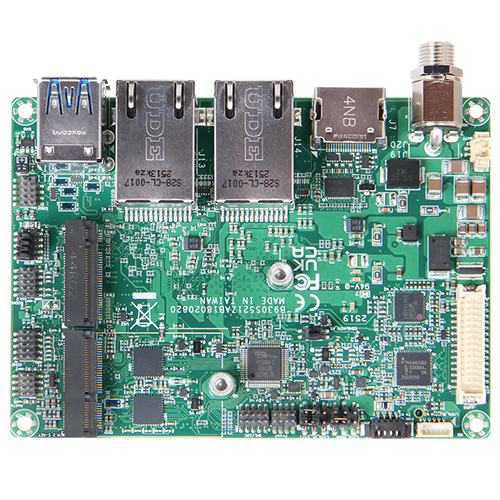
Against this industry backdrop, an embedded board that is able to integrate a high-performance CPU, dual Ethernet ports, multi-display capability and rich I/O on an compact 100 mm × 72 mm Pico-ITX form factor, while also providing wide temperature support, low power consumption, and TPM-based security, perfectly addresses the needs of industrial automation environments. It enables smart upgrades in constrained spaces. The PICO-8020 was designed precisely to solve these pain points.
The PICO-8020 is a Pico-ITX embedded motherboard measuring only 100 × 72 mm. It is powered by Intel® Processor N150 and Intel Atom® x7000RE series, offering customers a broad selection of configurations ranging from entry-level data acquisition nodes to edge controllers capable of real-time control and light vision workloads. For example, the N150 configuration is ideal for general equipment monitoring, digital signage, and gateway applications, while the x7433RE/x7211RE options provide more CPU cores and additional GPU execution units, making them well-suited for light-weight vision inference tasks.
Within its limited board area, the PICO-8020 offers a single DDR5-4800 SO-DIMM slot that supports up to 16 GB of memory. This is sufficient for multi-threaded data collection and containerized services, while maintaining low power consumption and low heat generation. It allows system designs to go fanless, reducing maintenance effort and avoiding dust buildup issues. The 12–24 V DC wide-range input makes it easy to install in machine control cabinets, on AGV chassis, or in edge boxes on production lines, without requiring additional DC/DC modules to match field power specifications. This effectively reduces BOM cost and design complexity.
To meet networking and field device connectivity needs, the PICO-8020 integrates two GbE ports. This allows system integrators to connect one Ethernet port to the OT network (PLCs, industrial switches, internal machine devices) and the other to the IT network, cloud, or upper-layer factory network, enabling network segmentation and enhanced security protection.
From a visual and HMI perspective, the PICO-8020 supports dual display outputs via HDMI® 2.0 and LVDS. It can simultaneously drive a Full HD/4K dashboard display and an embedded HMI inside the machine, fulfilling smart production lines’ requirements for real-time trend charts, alarm screens, and work order information. In addition, the M.2 2230 E-Key slot allows expansion with Wi-Fi/Bluetooth modules, enabling wireless maintenance access and mobile device connectivity. This is ideal for facility personnel to check equipment status nearby using tablets or smartphones.
To simplify instrumentation and machine integration, the PICO-8020 offers two RS-232/422/485 COM pin headers, two USB 2.0 pin headers, 8-bit GPIO, I2C, and SMBus on board. These can directly connect to field devices such as PLCs, motor drivers, signal towers, button panels, and temperature or environmental sensors, eliminating the need for multiple add-on expansion cards and improving overall system reliability.
On the security side, the board features an onboard TPM 2.0 module, making it easy to implement secure boot, disk encryption, and device identity authentication. For manufacturing customers that are increasingly focused on OT cybersecurity, this is a crucial factor when selecting edge nodes.
With Intel Atom® x7000RE processors, the PICO-8020 offers better GPU and inference capabilities. It can run AI inference frameworks such as OpenVINO on embedded Linux or Windows 11 IoT to handle tasks like simple defect inspection, presence/absence detection of components, or OCR recognition. This enables the board to function as a compact vision node for inline quality inspection.
In equipment monitoring and predictive maintenance scenarios, the PICO-8020 can serve as a data aggregation and analysis node. By using COM, GPIO, and I2C interfaces, it collects data from vibration, current, temperature, and humidity sensors into a local database. Containerized services running on the system then perform edge analytics, identifying abnormal trends in equipment behavior and enabling early warning for failures.
The Pico-ITX form factor offers high flexibility for space-constrained designs. The PICO-8020’s wide-temperature specification (with Intel Atom x7000RE models supporting -40°C to 85°C) and 5–95% non-condensing relative humidity rating allow it to operate reliably in harsh environments, such as outdoor warehouses, automated storage facilities, and high-temperature areas near production lines. This makes it ideal for deployment in compact robots, AGVs, and specialized inspection equipment where both ruggedness and small footprint are crucial.
A typical application is to mount an LVDS touch panel on the front of the equipment as an operator interface, while using HDMI® to output detailed data, trend charts, and alarm messages to a large on-site display. At the rear, dual LAN, COM ports, and the M.2 wireless module are used to connect PLCs, inverters, and cloud systems. This configuration creates a multi-functional node that combines HMI, data aggregation, and edge decision-making in a single platform.
In any automation project, a high-spec embedded motherboard alone is not enough to guarantee success. Equipment vendors are equally concerned with how reliably the board can be integrated into their mechanical design while meeting EMC requirements, safety certifications, thermal and power design constraints, as well as ensuring long-term supply and global service support.
Leveraging its years of experience, Portwell offers a DMS (Design and Manufacturing Services) model that delivers one-stop support, from early-stage planning, hardware and mechanical design, BIOS and firmware customization, all the way to mass production and global after-sales service. This service model helps customers turn embedded boards into truly market-ready systems or modules with strong competitiveness.
With Portwell DMS, customers can focus their resources on process know-how and application software development, investing more in differentiated features and innovative business models. In turn, this accelerates the realization of industrial automation and smart manufacturing value on the shop floor.