The industrial automation sector is under dual pressure: on one hand, operational challenges such as high-mix, low-volume production, shorter lead times, and tighter cost control; on the other hand, real-time data requirements driven by digital transformation and ESG initiatives. The traditional centralized PLC + SCADA architecture remains highly reliable for stability and real-time control, but it falls short in areas such as data analytics, equipment connectivity, and edge computing. When a production line must simultaneously handle machine monitoring, condition diagnostics, energy management, vision inspection, and cloud connectivity, relying solely on upstream servers or cloud resources can easily result in bandwidth bottlenecks and latency risks, making it difficult to perform time-critical decision-making at the edge.
At the same time, electrical and mechanical expansion capacity on the factory floor is limited, yet it must accommodate an increasing number of gateways, industrial PCs, and communication modules. When planning machine control or station-level control on the production line, factories are constantly making trade-offs among performance, power consumption, footprint, and reliability, while also taking into account 24/7 non-stop operation and harsh industrial conditions such as wide operating temperature ranges, vibration, and electromagnetic interference. On the networking side, IT/OT convergence is blurring the boundaries between facility networks, production control networks, and device-level sensor nodes. Using a single platform to support high-frequency data acquisition, industrial Ethernet communication, and secure cloud connectivity has become a common pain point for system integrators and equipment manufacturers.
Against this backdrop, small form factor industrial motherboards such as Nano-ITX are no longer merely “space-saving” options; they have become the core building blocks that enable modular production lines, smart machinery, and edge computing nodes. The ability to integrate computing performance, rich I/O, industrial-grade environmental tolerance, and security mechanisms within a compact footprint directly determines the competitiveness of the overall solution.
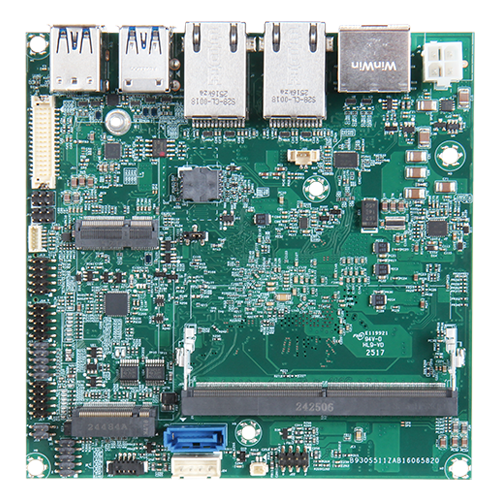
The NANO-6065 is a Nano-ITX embedded motherboard powered by Intel® Core™ Processor N-Series, Intel® Processor N-Series, and Intel Atom® x7000RE Series processors. It delivers sufficient computing performance for multi-task control and data pre-processing within a low-power envelope, making it an ideal core platform for equipment control, station-level control, or edge data gateway applications.
For memory, it supports a single DDR5 4800MT/s SO-DIMM module, up to 16GB. The onboard Intel® Graphics (up to 32 EUs) can drive triple independent displays, including two HDMI® 2.0b ports and one DisplayPort 1.4 via USB Type-C. This makes it easy to integrate on-machine HMI panels and external maintenance monitors, which is highly practical for automation equipment that needs to present local operation screens and diagnostic information.
I/O connectivity is critical for industrial automation applications. The NANO-6065 integrates dual 2.5GbE LAN ports, three USB 3.2 Gen2 Type-A and one USB 3.2 Gen2 Type-C port (supporting both DP 1.4 output and USB device mode), two RS-232/422/485 ports (BIOS-selectable), eight GPIO channels, as well as SATA III and a Micro SD slot. This allows the board to act simultaneously as a communication node for PLCs, variable frequency drives (VFDs), and servo drives, as a data backbone for industrial cameras and peripherals, and as a local storage node for data logging and caching.
In terms of expandability, it provides one M.2 Key E (2230, USB / PCIe) and one M.2 Key B (3052 / 2280, USB / PCIe / SATA) slot, enabling flexible integration of Wi-Fi / Bluetooth, 4G / 5G modules, or NVMe SSDs for communication and storage options. This gives system integrators the customization headroom needed to accommodate diverse communication configurations across different production lines and equipment architectures.
From a cybersecurity and long-term maintenance perspective, the onboard TPM 2.0 supports secure boot, key management, and certificate storage, helping implement device-level security controls in industrial environments and laying a solid foundation for future firmware updates or remote operation and maintenance.
Overall, with its low-power x86 platform, industrial-grade I/O configuration, and flexible expansion design, the NANO-6065 directly addresses key pain points in industrial automation, such as space constraints, compute upgrades at the edge, network convergence, and strengthened cybersecurity, positioning itself as one of the preferred choices for customers planning next-generation edge controllers and smart machinery.
In real-world deployments, the NANO-6065 is typically integrated into an all-in-one industrial computer or embedded into a customized mechanical enclosure, serving as the computing core for a single machine or station. The following representative industrial automation scenarios illustrate the practical value it delivers:
The NANO-6065 can simultaneously take on multiple roles such as soft-PLC, HMI, and data logger. With dual 2.5GbE LAN ports, one Ethernet port can be used to build a control network with servo drives, I/O modules, or robot controllers, while the other Ethernet port provides uplink connectivity to the plant network, MES/SCADA systems, or cloud platforms. Multiple serial ports allow connection to existing RS-485 or RS-232 devices, helping customers gradually migrate towards a software-defined control architecture on legacy production lines.
Leveraging its high-bandwidth Ethernet and USB 3.2 interfaces, the NANO-6065 can aggregate data from multiple PLCs, power meters, sensors, and industrial cameras, perform data pre-processing and event detection at the edge, and then upload consolidated results and critical anomalies to the cloud or enterprise databases. This approach reduces the bandwidth and storage burden caused by transmitting raw data streams in large volumes.
For processes that require basic vision support, such as simple barcode/OCR reading, presence/absence checks, or basic appearance inspection, the NANO-6065 can connect to multiple industrial cameras via USB 3.2 Gen2 and work with third-party software for image acquisition and algorithm inference in machine vision applications. Although these workloads can be compute-intensive, with proper planning of image resolution and algorithm complexity, the NANO-6065 can meet the visual inspection requirements of single stations and low- to mid-speed production lines. Inspection results can be fed directly back to PLCs or production management systems to form a closed-loop control.
For system integrators and equipment manufacturers, the greatest value of the NANO-6065 lies not only in its hardware specifications, but in the design and O&M efficiency enabled by its “multi-role” capabilities. A single hardware platform can cover HMI, edge gateway, data logging, and lightweight image recognition applications, helping reduce long-term TCO and improve overall operational efficiency.
For industrial automation customers, choosing a suitable embedded motherboard is only the starting point. What truly determines the success of a project is the end-to-end value chain, from upfront architecture design and system validation to integration, mass production, and long-term operation and maintenance. Portwell DMS (Design & Manufacturing Services) extends customer requirements into application-specific platforms that are closely aligned with real-world deployment scenarios.
For system integrators, equipment builders, and end manufacturers in the industrial automation domain, DMS-enabled platforms can be deeply integrated with mechanical design, electrical control, and production processes. Through an integrated service model of professional consulting + customized design + high-quality manufacturing + long-term lifecycle services, customers can focus on process engineering and application innovation, while entrusting the selection, implementation, and maintenance of control and edge computing platforms to a dedicated expert team. This approach effectively amplifies the value of industrial automation projects across the entire equipment lifecycle.