Industrial automation worldwide is accelerating as manufacturers strive for higher throughput, quality, and safety while contending with labor shortages and rising operational costs. At the same time, OT and IT teams face mounting pressure to improve sustainability, minimize downtime, and strengthen OT network security. Edge computing within the plant has become a critical enabler—processing data closer to machines, reducing latency, and limiting what needs to be transmitted to the cloud. This approach enhances responsiveness, operational resilience, and data protection. Against this backdrop, compact, efficient, industrial-grade embedded boards have emerged as a dependable foundation for HMIs, IoT gateways, vision systems, and cell controllers.
As automation architectures evolve, the requirements for embedded mainboards have shifted. Designers now seek boards that combine long-life CPU roadmaps with fanless, energy-efficient performance—critical for sealed cabinets, DIN-rail PCs, and compact edge nodes. Equally important is comprehensive connectivity: dual LAN for segregated OT/IT networks, multiple serial ports for legacy PLC and fieldbus devices, USB for sensors and cameras, and GPIO for alarms and control signals.
Edge workloads such as AI-based inspection, condition monitoring, and local analytics demand higher memory bandwidth and graphics capability without compromising industrial robustness. There is also a clear trend toward time-sensitive networking (TSN) and secure operation, including secure boot and TPM-backed key storage. Finally, OEMs prioritize wide-voltage and wide-temperature support, enabling a single board SKU to serve multiple machine families and global deployments—simplifying BOMs and service logistics.
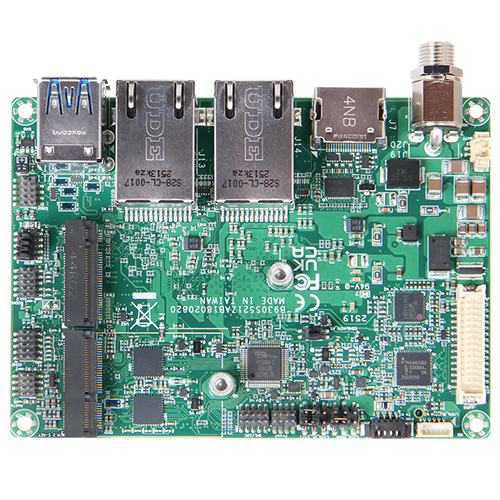
Portwell’s PICO-8020 Pico-ITX industrial-grade embedded board addresses the evolving needs of automation systems. Measuring just 100 mm x 72 mm, it supports either the Intel® Processor N150 or Intel Atom® x7000RE series (x7433RE or x7211RE), with typical TDP between 6–12 W—ideal for fanless designs in compact enclosures. The N150 delivers quad-core performance up to 3.6 GHz for cost- and power-sensitive HMI, gateway, and data-logging applications, while Atom x7000RE SKUs provide additional headroom for heavier edge workloads and extended temperature variants. Paired with DDR5-4800 SO-DIMM, the board offers significantly higher memory bandwidth than DDR4 or DDR3 platforms, enabling more camera streams, higher-resolution dashboards, and faster analytics.
Connectivity includes dual Intel® I210 GbE ports for network segregation or redundancy; two multi-protocol COM ports (RS-232/422/485) for PLCs and legacy devices; four USB ports (2x USB 3.2 Gen 2, 2x USB 2.0) for cameras and service access; and 8 GPIO interfaces for alarms and control signals. HDMI® and LVDS outputs support dual independent displays—ideal for combining a local operator HMI with an overhead line display. Storage and expansion options include an M.2 Key M 2242 socket for PCIe or SATA SSDs and an M.2 Key E 2230 slot for Wi-Fi/Bluetooth connectivity, supporting wireless cells and AGV/AMR use cases.
Hardware security is built in via TPM 2.0, helping OEMs meet cybersecurity best practices and OS requirements such as Windows 11. A wide 12–24 V DC input and optional wide-temperature components enable streamlined integration across diverse cabinets, panels, and edge boxes without redesign.
For industrial automation OEMs, the PICO-8020 translates its specifications into practical benefits across diverse applications. In production line controllers or machine-level gateways, dual GbE LAN, serial ports, and multiple GPIOs enable seamless bridging between legacy field devices and modern IIoT platforms, while low TDP and wide-voltage support simplify integration into compact cabinets. In HMI terminals or operator workstations, dual-display capability and DDR5 memory deliver smooth visualization and responsive interfaces as data volumes grow. For edge analytics and vision-assisted stations—such as quality inspection, robot guidance, or safety monitoring—the combination of power-efficient Intel® processors, fast memory, and high-speed USB supports local image and sensor data processing, reducing latency and bandwidth demands compared to cloud-only approaches.
Backed by Portwell’s industrial design expertise and long-lifecycle support, the PICO-8020 provides a stable, scalable foundation for next-generation machines and production cells, helping OEMs build connected, resilient automation systems within accelerated timelines.