Market Trends Driving the Rise of SD-Branch
As digital transformation accelerates, traditional branch networks can no longer meet the demands of cloud-centric and highly distributed operations. SD-Branch has emerged as a streamlined approach that unifies WAN, LAN, security, and centralized management into a single software‑defined platform. In parallel, the rapid growth of edge AI and IoT is pushing intelligence closer to the network edge. Enterprises increasingly require resilient, compact platforms capable of local processing, real-time visibility, and seamless connectivity to the cloud or headquarters. These demands are driving the rapid adoption of SD-Branch architectures across retail, industrial edge, and remote environments
Hardware Requirements for SD-Branch Applications
To enable modern SD-Branch deployments, embedded computing platforms have become well-suited solutions, delivering a balance of performance, flexibility, and reliability. High-throughput networking with multi‑speed interfaces is essential to handle diverse and dynamic traffic demands, while modular expandability ensures readiness for emerging technologies such as AI acceleration, 5G connectivity, and scalable storage.
Power efficiency and system resilience are equally critical in mission‑critical environments where uptime is non-negotiable. Features such as hardware bypass, redundant power inputs, and wireless failover are now baseline requirements rather than optional enhancements. Functional consolidation is also increasingly important. By integrating routing, switching, security, PoE, and AI computing into a single platform, organizations can reduce hardware footprint, simplify deployment, and lower operational costs.
Finally, seamless integration with software ecosystems and adherence to open standards—such as OCP NIC 3.0—provide a strong foundation for future‑proof architectures and faster time‑to‑market.
Portwell SD-Branch Solutions: Architecture and Key Benefits
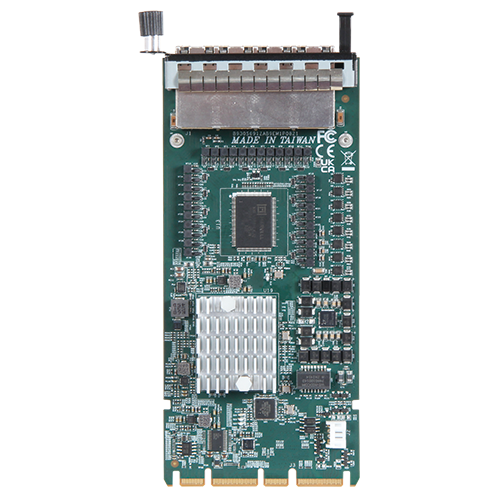
Portwell’s SD‑Branch solutions address these requirements through a modular, OCP-based architecture. The PSD-AN2P0-EXP AI Accelerator Expansion Card, powered by NVIDIA® Jetson Orin™, enables real-time AI inference for traffic analytics, security monitoring, and IoT event detection at the edge. With integrated dual-port PoE+ delivering up to 60W total power, it consolidates connectivity and power delivery for cameras and sensors—eliminating the need for external devices and simplifying deployment.
The PSD-EM1P0-EXP PoE+ Switch Card enhances network functionality with L2+ smart management and high‑power PoE+ (up to 60W total power), enabling direct connection of edge devices while maintaining flexible integration through the OCP NIC 3.0 form factor.
At the system level, PNAC-32300 delivers high-performance 2.5GbE connectivity, Intel Atom® x7809C processing, hardware bypass, and OCP expansion, making it ideal for scalable SD-WAN and SASE deployments. Meanwhile, PNAC-31110 provides multi-speed 10GbE and 2.5GbE interfaces, dual DC power input, wireless-ready M.2 expansion, and flexible modular configurations using Portwell-designed ETSFF (OCP NIC 3.0 4C+ connector) PoE+ switch or AI‑accelerator expansion cards.
Together, these platforms enable the integration of networking, computing, and AI capabilities within a single system— transforming traditional branch infrastructure into a unified, intelligent edge environment.
Enabling the Future of Intelligent Branch Infrastructure
Portwell’s SD-Branch solutions enable enterprises to deploy scalable, all-in-one platforms that combine routing, switching, security, PoE, and AI within a unified architecture. This approach simplifies deployment, reduces hardware footprint, and supports granular network control with centralized management across distributed environments.
By supporting AI-driven analytics, wireless connectivity, and modular scalability, Portwell helps organizations optimize branch performance, improve operational efficiency, and reduce total cost of ownership. From retail and finance to industrial IoT and smart campuses, these solutions provide a reliable, future-ready foundation for intelligent edge networking—today and into the next generation.