Semiconductor devices undergo final testing after packaging. This verifies device functionality and quality. Equipment manufacturers can integrate test equipment with an automated handler. The handler positions devices and sorts them based on test results. As chip functionality expands and multisite testing requirements increase, the system controller faces heavy demands. Specifically, it must simultaneously execute test programs, control equipment, log data, and connect to factory systems.
Centralized Test Result Management Accelerates Semiconductor Device Binning and Data Reporting
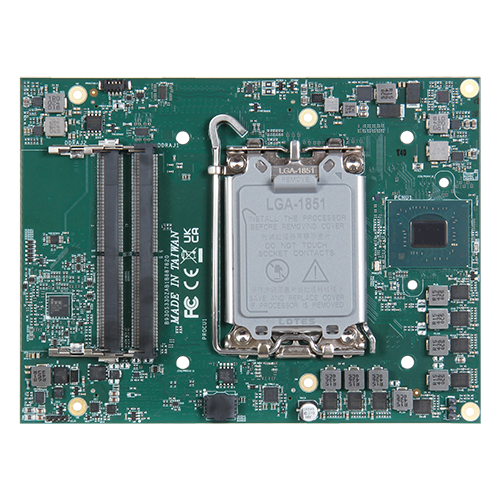
Specifically, PCOM-B887 serves as the control and data-processing platform for semiconductor package final test equipment, managing test workflows and equipment status. After each device is tested, the system sends test disposition and binning results to the handler, which routes the device to the appropriate output bin. Test records and production data are also returned to the test management system. Centralizing result processing and data reporting streamlines data exchange among equipment, improving production traceability and management efficiency.
Heterogeneous Computing Supports Concurrent Test and Management Workloads
Powered by the Intel®Core™ Ultra 200S processor family, PCOM-B887 integrates CPU, GPU, and NPU resources. The CPU manages test workflows, equipment control, and data management; the GPU accelerates parallel data processing and result visualization; and the NPU supports AI inference for anomaly classification, equipment condition analysis, and predictive maintenance. In a multisite test environment, workloads can be assigned to the appropriate compute engine to support efficient execution of concurrent tasks. The integrated NPU also provides an expansion path for future AI applications, including anomaly classification and predictive maintenance.
High-Capacity Memory and High-Speed Expansion Support Multisite Testing
With support for up to 192GB DDR5, PCOM-B887 provides memory capacity for buffering multisite test data, retaining historical records, and running multiple software services. PCIe Gen5 and Gen4 expansion can accommodate FPGA cards, test interface cards, networking modules, or equipment-control modules based on system requirements. With a custom carrier board, equipment manufacturers can configure functions for different machine designs and test requirements while retaining flexibility for future platform upgrades.
PCOM-B887 Key Specifications
- Intel®Core™ Ultra 200S with Integrated NPU
- Up to 192GB DDR5
- PCIe Gen5 / Gen4
- Dual 2.5GbE and USB4
- COM-HPC Client Size C
- TPM 2.0
From Design-In to Volume Production, Reduce Equipment Integration Risk
Developing semiconductor package final test equipment requires more than selecting a computing platform. The design must also address interface requirements, thermal management, mechanical integration, software compatibility, and long-term product availability. Portwell provides custom carrier board design, firmware tuning, system validation, volume-production ramp-up support, and lifecycle management to help equipment manufacturers shorten development cycles while improving long-term serviceability and platform upgrade flexibility.