Market Trends in Medical & Healthcare Sector
The healthcare industry is undergoing rapid digital transformation, driven by the growing adoption of electronic medical records (EMR), telemedicine, AI‑assisted diagnostics, and smart hospital infrastructure. Hospitals and healthcare providers are increasingly shifting toward interconnected, data‑driven environments where real‑time monitoring, seamless data exchange, and system interoperability are essential.
At the same time, demand is rising for decentralized edge‑computing solutions that reduce latency, enhance data privacy, and ensure continuous system operation—even in network‑limited environments. Applications such as bedside terminals, medical carts, imaging displays, and ward information systems require compact, reliable, and secure embedded platforms capable of operating 24/7 under varying environmental conditions. As a result, healthcare system integrators are prioritizing solutions that combine high reliability, long lifecycle support, and robust security features, while maintaining cost efficiency.
Hardware Requirements for Medical Embedded Systems
Medical and healthcare applications impose stringent requirements on embedded computing hardware. First and foremost, system reliability and stability are critical, as failures can directly impact patient care and clinical outcomes. Hardware must support long‑term operation with minimal maintenance, often in environments subject to vibration, temperature fluctuations, and continuous use.
Data security is another key concern, requiring hardware‑based encryption and secure boot mechanisms to protect sensitive patient information and support regulatory compliance. Connectivity is equally important, with support for dual‑network architectures to enable IT network segmentation between medical devices and hospital information systems. In addition, backward compatibility with legacy medical equipment through serial interfaces (e.g., RS‑232) remains essential.
Compact form factors are required for integration into space‑constrained devices such as medical carts and bedside systems, while flexible I/O expansion is necessary to support peripherals including scanners, cameras, touch panels, and monitoring devices. Finally, low power consumption and standardized power input are crucial for mobile and energy‑sensitive medical equipment.
PICO-8021 Pico-ITX SBC Benefits for Medical Applications
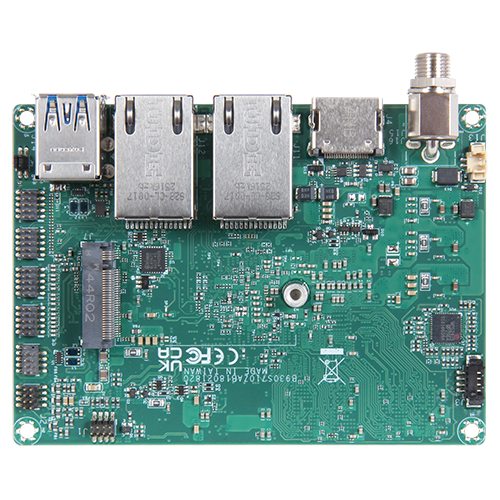
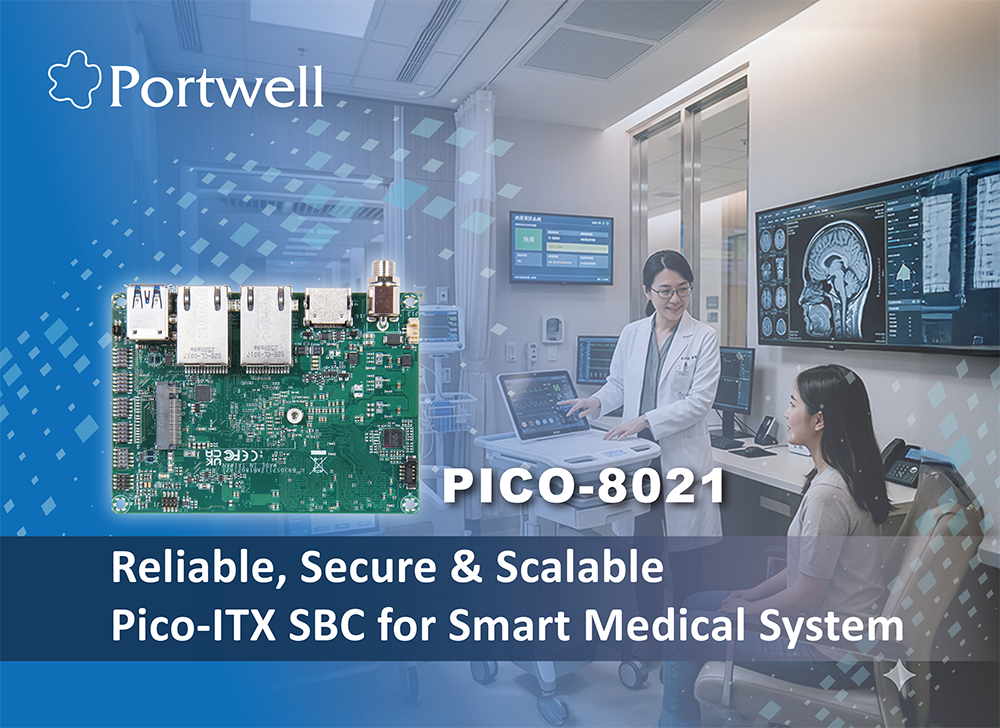
Portwell PICO‑8021 Pico‑ITX SBC is purpose‑built to address these healthcare requirements through a balanced combination of performance, efficiency, and reliability in a compact footprint (100 x 72 mm). Powered by Intel® Processor N150 and Intel Atom® x7000RE Series processors, the board delivers up to quad‑core processing with an approximate 9W TDP, enabling efficient multitasking and stable operation for real‑time medical applications such as imaging display and patient monitoring.
Integrated LPDDR5 memory, soldered onboard, enhances memory bandwidth while improving resistance to shock and vibration—making it well suited for mobile medical carts and ward‑based equipment. Storage flexibility via M.2 2242 supports medical record management and image buffering, ensuring smooth and reliable data handling.
From a connectivity and security perspective, PICO‑8021 features dual Intel® I210 Gigabit Ethernet ports, enabling network redundancy and secure segmentation between hospital IT systems and medical devices. The inclusion of TPM 2.0 provides hardware‑level encryption to safeguard patient data and strengthen cybersecurity compliance. Legacy compatibility is ensured through dual RS‑232 interfaces, allowing seamless integration with existing medical measurement and monitoring equipment.
Rich I/O options, including USB 3.2, USB 2.0 headers, HDMI® 1.4, GPIO, and audio interfaces, support a wide range of peripherals such as medical cameras, barcode scanners, touch displays, and voice‑interaction systems. Furthermore, the board’s wide operating temperature range (-45°C to 85°C, depending on SKU) and industrial‑grade design ensure reliable performance in demanding healthcare environments. Its compact Pico‑ITX form factor enables easy integration into space‑constrained medical devices without compromising functionality.
Enabling Secure, Scalable, and Cost-Efficient Smart Healthcare
Portwell PICO‑8021 stands out as a versatile and reliable embedded computing platform tailored for modern healthcare applications. By combining low‑power Intel® processors, industrial‑grade durability, robust security features, and comprehensive connectivity, it effectively addresses the evolving demands of digital healthcare infrastructure.
The platform supports critical applications such as bedside terminals, medical carts, and imaging systems, while also helping system integrators accelerate development cycles and build cost‑effective systems. As the medical and healthcare sector continues to move toward smarter, more connected environments, PICO‑8021 provides a stable and scalable foundation for secure, efficient, and future‑ready medical solutions.