Industry: Warehousing & Logistics
Country: Europe
AGV/AMR 24/7 Automated Operations: Edge Control Platforms Become the Core
As smart manufacturing, e-commerce logistics, semiconductor warehousing, automotive parts distribution, and large-scale in-plant logistics continue to accelerate, AGVs and AMRs are evolving into intelligent mobile nodes capable of working collaboratively with warehouse management systems, dispatching systems, production line equipment, sensors, and cloud platforms. For field operations, the greatest value of unmanned handling robots lies in their ability to reliably perform material replenishment, pallet handling, semi-finished goods transfer, finished goods warehousing, and cross-zone transportation under 24/7 operating conditions. Through real-time path planning and system-level dispatching, they help improve overall logistics efficiency.
However, AGV/AMR deployment environments are typically highly dynamic, densely populated, and subject to stringent safety requirements. These systems must determine travel paths in real time among warehouse racks, conveyor lines, operators, forklifts, and other mobile equipment, while simultaneously processing multi-source data from LiDAR, IMU, radar, GNSS, cameras, and wireless communication modules. If the computing platform cannot integrate sensor information in real time, it may lead to delayed path decisions, insufficient obstacle avoidance response, inefficient fleet dispatching, or difficulties in equipment maintenance.
Edge Computing Architecture for Sensor Integration and Real-Time Decision-Making: PCOM-BA03
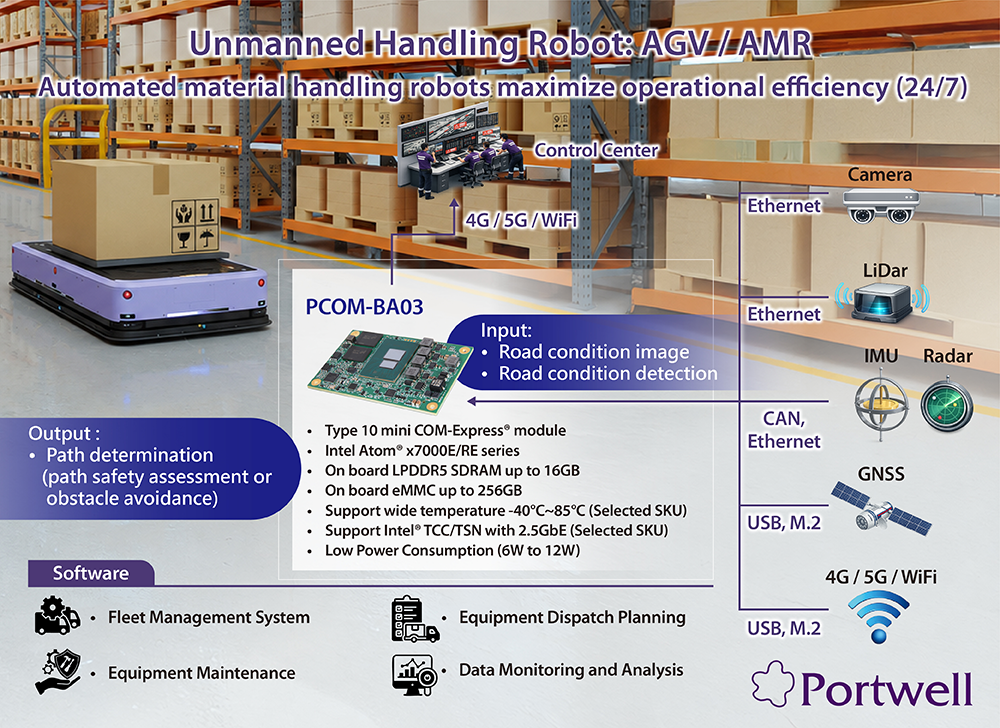
As AGV/AMR systems are increasingly deployed in smart warehousing, in-plant logistics, and unmanned material handling applications, real-time control, sensor integration, and long-term operational reliability have become essential requirements. Portwell PCOM-BA03 can serve as the core edge computing module for unmanned handling robots, helping customers build a low-power, highly reliable, and easy-to-integrate mobile control platform. Positioned as the central computing layer of an AGV/AMR system, PCOM-BA03 receives data from environmental imaging, route condition detection, and multiple sensors, then processes this information in real time to generate path decisions, route safety assessments, and obstacle avoidance results. This enables robots to operate continuously, autonomously, and safely in complex environments where warehouse racks, conveyor lines, operators, and other mobile equipment coexist.
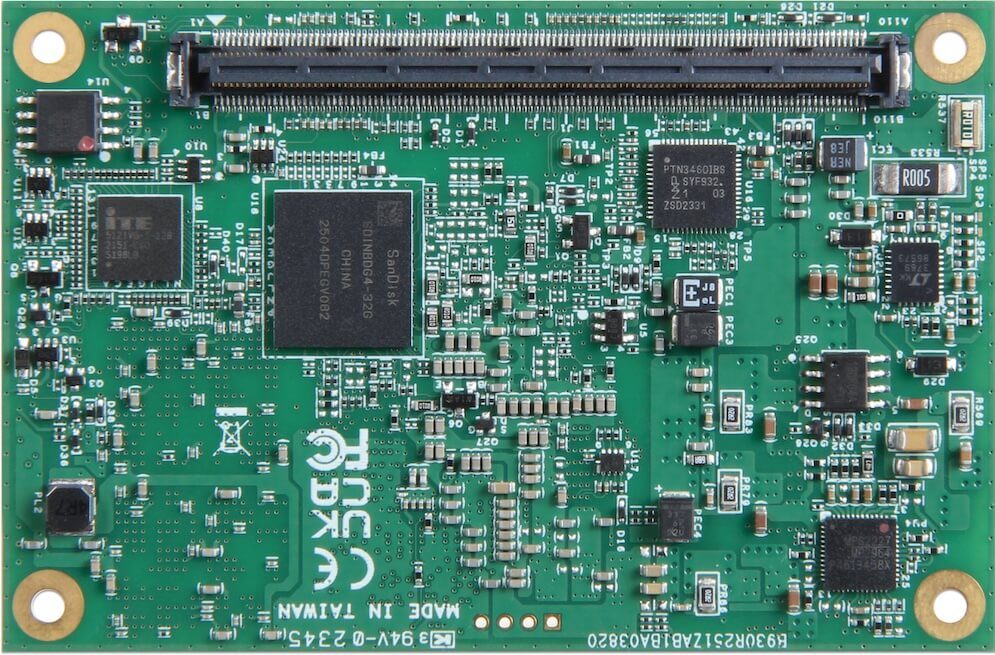
PCOM-BA03 adopts a Type 10 mini COM Express module design and is powered by Intel Atom® x7000E/RE series processors. With its low-power and stable computing characteristics, it is well suited for AGV/AMR onboard systems where space is limited, thermal conditions are challenging, and continuous operation is required. The module supports onboard LPDDR5 SDRAM up to 16GB, enabling efficient processing of multi-sensor data, route decision-making, and equipment status monitoring. It also supports onboard eMMC up to 256GB for storing system firmware, mission records, vehicle status data, and basic application programs. Compared with higher-power computing platforms, PCOM-BA03’s 6W to 12W low-power design helps reduce the power load of onboard systems, contributing to longer AGV/AMR operating time and greater flexibility in thermal design.
From Single-Unit Control to Fleet Management: Enabling Greater System Development Flexibility and Business Value
For product applications, development cycle and platform scalability are critical factors that influence market competitiveness. The PCOM-BA03 adopts a modular architecture, helping customers maintain a relatively consistent system design logic across different product generations while adjusting carrier boards, I/O configurations, communication modules, and storage specifications according to application requirements. This allows the platform to more easily support various deployment scenarios, including warehouses, factories, logistics centers, ports, and outdoor environments.
In applications such as fleet management systems, equipment dispatch planning, equipment maintenance, and data monitoring and analytics, the management platform can access vehicle location, task status, battery information, route records, and abnormal events in real time, further optimizing dispatching sequences and logistics flow. When combined with data analytics, operators can also use historical task data to evaluate bottleneck routes, equipment utilization, and maintenance cycles, transforming AGVs and AMRs into valuable data nodes within the smart logistics system.
Portwell DMS Services
Portwell’s DMS services support customers throughout the complete process from design, validation, and manufacturing to post-deployment service. Based on customer requirements for hardware space, thermal conditions, power design, I/O configuration, communication needs, and mass production planning, Portwell can provide customized carrier board design, system integration, testing and validation, and manufacturing support. Through a one-stop service model, customers can shorten development timelines, reduce supply chain and engineering integration risks, and accelerate the deployment of smart logistics and unmanned handling applications with more stable product quality.