Industry: Healthcare / Medical
Country: North America
As global healthcare moves toward precision diagnostics and distributed care, ultrasound devices have become essential medical platforms. They seamlessly integrate image processing, data transmission, and human-machine interaction within clinical workflows.
Ultrasound systems offer real-time imaging, non-invasive procedures, and high deployment flexibility. Because of these advantages, they are widely used across various medical fields. These include emergency rooms, obstetrics, cardiovascular care, and mobile healthcare scenarios.
Challenges in Modern Ultrasound Equipment Design
However, as imaging resolution continues to improve, probe signal processing becomes more complex, and clinical users demand more responsive operating interfaces and diagnostic assistance functions, the challenges facing ultrasound system developers have expanded into multiple areas. These include high-performance computing, compact system architecture, long-term availability, low-power thermal design, medical system integration, and product lifecycle management. For medical device manufacturers, implementing a stable and reliable core computing platform within a limited mechanical space, while supporting high-resolution image output, multi-interface peripheral connectivity, and future functional upgrades, has become a critical factor in ultrasound equipment design.
Core Computing Architecture for Ultrasound Devices: PCOM-B659
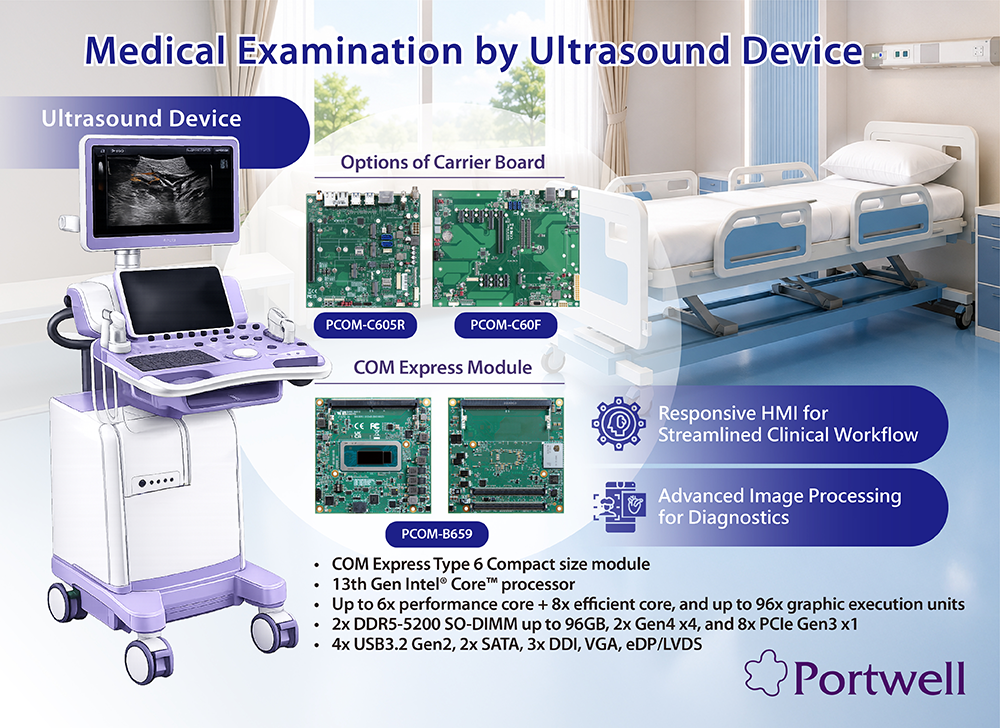
To address the requirements of medical ultrasound examination devices for high performance, stability, and platform scalability, the Portwell PCOM-B659 COM Express Type 6 Compact module can serve as the core computing engine inside the equipment. It helps customers build an embedded platform that combines image processing, HMI operation, and system control capabilities.
Powered by the 13th Gen Intel®Core™ processor platform, PCOM-B659 supports up to 6 Performance-cores and 8 Efficient-cores, along with up to 96 graphics execution units. This enables the platform to handle ultrasound image signal processing, real-time image display, diagnostic workflow control, and multitasking applications. In clinical environments, ultrasound systems must present scanning images, parameter settings, measurement markers, and examination data in real time while physicians operate the probe. Therefore, the system platform must deliver fast response and stable graphics output.
Through its COM Express modular design, PCOM-B659 allows equipment developers to separate the core computing module from the customized carrier board. Based on different product line requirements, customers can select carrier board options such as PCOM-C605R or PCOM-C60F, accelerating prototype validation, feature development, and subsequent mass production deployment.
From Image Processing to HMI Operation, Enhancing the Value of Medical Devices
Within the ultrasound system architecture, PCOM-B659 supports a wide range of medical peripheral functions through comprehensive I/O and high-speed data channels. It supports DDR5-5200 SO-DIMM memory with a capacity of up to 96GB, which benefits image buffering, real-time data processing, and simultaneous operation of multiple applications. PCIe Gen4 x4 and PCIe Gen3 x1 can be used to connect image acquisition modules, signal processing boards, AI acceleration modules, or high-speed storage devices. USB 3.2 Gen2 can support touch panels, scanners, external storage, medical peripherals, or maintenance interfaces. SATA can be used for system storage and examination data retention.
This architecture helps reduce duplicated development efforts across different device models. High-end ultrasound systems can leverage greater computing performance to support advanced image processing and diagnostic assistance functions, while mid-range or entry-level models can adjust product positioning through different carrier board and peripheral configurations. For clinical users, a stable and responsive HMI interface can shorten examination time and reduce waiting time during image adjustment, patient data entry, and reporting workflows. Real-time image processing capability also helps improve diagnostic efficiency and the overall examination experience.
DMS Services Accelerate Medical Device Development from Design to Production
In addition to the core computing platform, Portwell provides DMS(Design and Manufacturing Services)to support customers across the complete process from specification definition, carrier board design, BIOS customization, I/O configuration, mechanical integration, and thermal validation to mass production manufacturing. For customers, the value of DMS lies not only in shortening development cycles, but also in reducing system integration risks, improving product consistency, and helping build a medical embedded platform with long-term availability, maintainability, and scalability. This enables ultrasound examination devices to respond more rapidly to clinical market demands for high performance, reliability, and intelligent diagnostic workflows.