Industry: Energy
Country: Europe
Offshore Drilling Platforms Require Reliable Explosion-Proof Computing Architecture
Offshore drilling platforms are among the most demanding industrial environments in the energy sector. These facilities face extreme conditions daily. They endure high humidity, salt mist, strong waves, and heavy vibration. They are also exposed to oil emissions and drilling mud contamination under 24/7 operations. On-site equipment must withstand these harsh environments. More importantly, it must maintain stable operation in potentially explosive atmospheres. High-risk areas include drilling operation zones, mud circulation systems, and pump control areas. Data acquisition zones and operator stations also face severe hazards. In these locations, oil leaks, flammable vapors, and electrical ignition sources can occur simultaneously.
Three Major Operational Challenges
In real-world deployment, offshore platforms face three major operational challenges. The first is safety compliance. Equipment in hazardous areas must meet strict certifications. These include ATEX Zone 2 or Class I Division 2 standards. This prevents electrical devices from becoming ignition sources.
The second challenge is environmental reliability. Systems must resist severe vibration, moisture, and corrosion. They must also endure high-load continuous operation. This prevents HMI failures or communication drops from causing operational blind spots.
The third challenge is system integration complexity. Offshore platforms simultaneously operate PLCs, sensors, and data acquisition modules. They also rely on isolated power systems. Without a stable industrial HMI and reliable connectivity, visualizing field data becomes very difficult. Consequently, maintenance and troubleshooting costs can rise significantly.
WTPE Series as the Control Core for Offshore Drilling Platforms
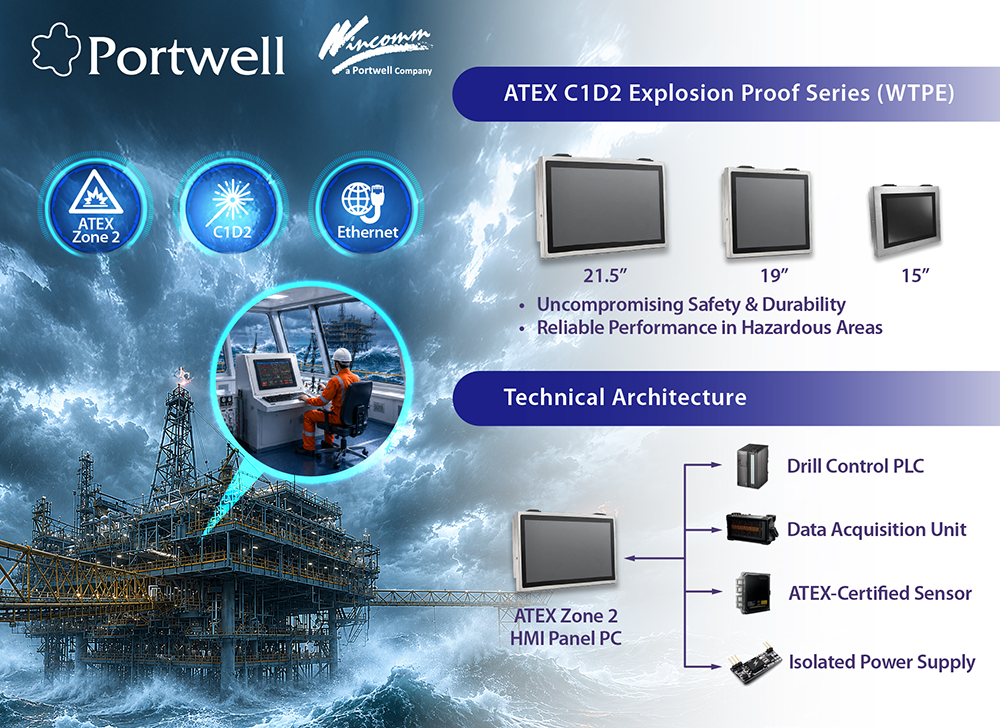
To address these challenges, the WTPE Series, an ATEX C1D2 explosion-proof panel PC platform, can serve as both the human-machine interface and edge control node in hazardous areas of offshore drilling platforms. It helps customers build a safer and more stable operating platform for drilling control, mud monitoring, pump management, and field data integration. Based on different application requirements, the WTPE Series offers 21.5-inch, 19-inch, and 15-inch display options, supporting deployment in main control rooms, field operation consoles, auxiliary drilling monitoring stations, or equipment-side HMI installations. This allows customers to configure the system flexibly according to site space, viewing distance, and operating conditions.
During drilling operations, the WTPE Series can be deployed in ATEX Zone 2 application areas and connected with field devices such as drill control PLCs, data acquisition units, ATEX-certified sensors, and isolated power supplies. The PLC is responsible for drilling control logic, pump start-stop control, equipment interlocking, and safety protection. The data acquisition unit collects signals such as pressure, temperature, rotational speed, flow rate, and mud status. ATEX-certified sensors provide critical parameter feedback in hazardous environments, while the isolated power supply helps reduce the impact of electrical noise, surges, and grounding issues on system stability. As a field HMI and data visualization endpoint, the WTPE Series integrates distributed equipment data into an operator-friendly control interface, enabling field personnel to monitor drilling status, equipment load, and abnormal alarms in real time.
The Value of WTPE Series: Integration Capability
Within the technical architecture of an offshore drilling platform, the HMI is an important edge node that connects OT field control with upper-level management systems. The WTPE Series exchanges data with PLCs, DAQ devices, sensor modules, and control equipment, supporting field monitoring software to display real-time trend charts, equipment status, alarm information, operation records, and maintenance notifications. For platform operators, this means that personnel can directly access key drilling system data in explosion-proof environments, including mud pressure changes, pump operating status, drill string load, equipment abnormalities, and safety interlock conditions. This further reduces manual interpretation delays and information gaps.
In terms of application scenarios, the 21.5-inch model is suitable for main operating stations or drilling control areas that require integrated multi-information displays, allowing operators to view process diagrams, trend curves, and alarm windows at the same time. The 19-inch model can serve as a standard field control interface, balancing display size with cabinet integration flexibility. The 15-inch model is ideal for equipment-side installation, local control panels, or auxiliary monitoring nodes where space is limited. Through a product lineup with multiple display sizes, customers can establish a multi-point HMI deployment model under the same platform architecture, enabling key operation areas, equipment control zones, and maintenance endpoints to share consistent operating logic and data sources.
Portwell DMS: from Design to Deployment
Portwell DMS, which stands for Design and Manufacturing Services, provides customers with complete support from requirement definition, hardware design, mechanical integration, manufacturing testing, and mass production delivery. For offshore drilling platforms and hazardous-area applications, customers require customized solutions that can meet on-site installation conditions, system connectivity requirements, power architecture, and long-term supply needs. Through DMS capabilities, Portwell helps customers reduce development risks, accelerate project deployment, and build reliable industrial systems for mission-critical energy applications.