Manufacturers are rapidly adopting automation and AI-based inspection. As a result, robotic arms are evolving from simple pick-and-place equipment into intelligent inspection nodes. These nodes integrate industrial cameras, sensors, and edge computing. From semiconductor wafer inspection to surface inspection in electronics, automotive, food, and medical device manufacturing, modern production lines must capture images, analyze data, and execute motion within limited system space.
Challenges in Modern Smart Factories
Consequently, the system challenges of vision inspection have expanded beyond image recognition. Today, production lines must integrate sensing, computing, control, and display functions at the same time. For instance, cameras, lighting systems, and position sensors must work seamlessly with robotic arms and conveyors. Together, they support real-time positioning, measurement, defect detection, and pick-and-place verification. Furthermore, as image resolution, camera quantity, and AI model complexity continue to increase, systems require powerful image processing along with high-speed computing coordination. Ultimately, this helps prevent image analysis or control response from becoming a bottleneck on the production line.
PCOM-B65C for Factory Machine Vision and Robotic Arm Applications
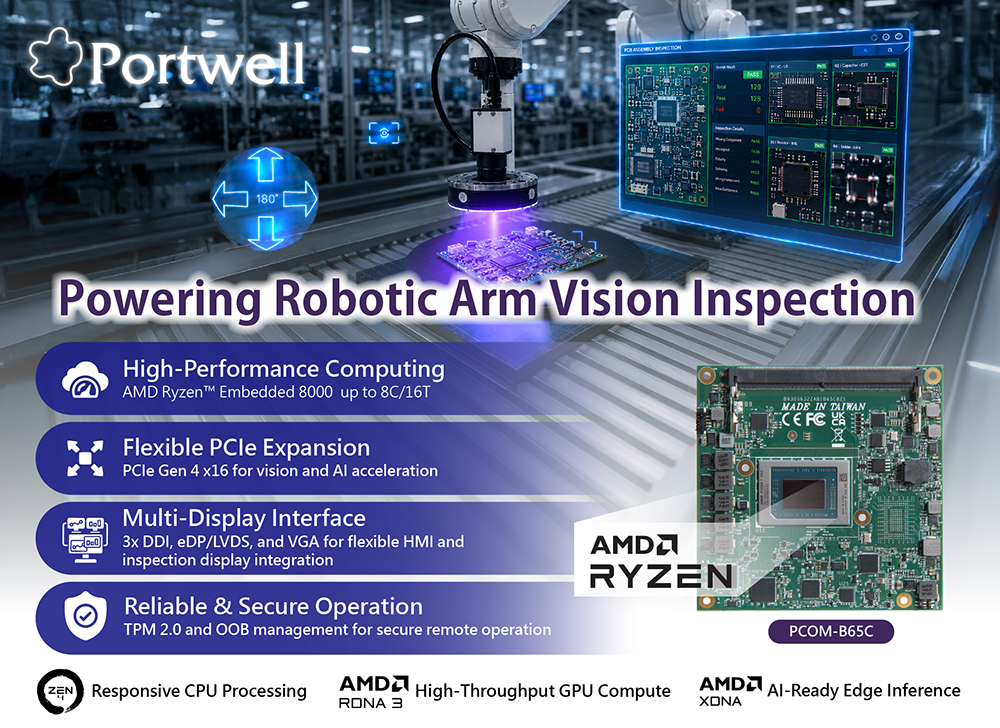
PCOM-B65C brings heterogeneous computing, multi-display support, and high-speed expansion to machine vision robotic arm systems in smart factories.
High-Efficiency Edge Computing with CPU, GPU, and NPU Integration
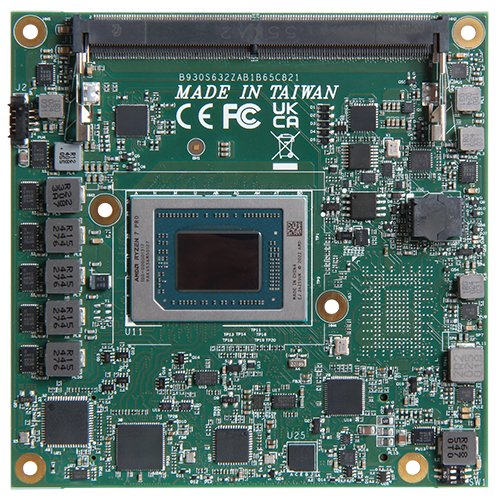
PCOM-B65C adopts the COM Express Type 6 Compact form factor with a 95 x 95 mm footprint. It is well suited for space-constrained edge computing platforms used in semiconductor automation equipment, industrial robotic arm control, and vision inspection systems. The PCOM-B65C is powered by AMD Ryzen Embedded 8000 Series processors, supporting up to 8 cores and 16 threads. Furthermore, it integrates a Zen 4 CPU, AMD RDNA 3 Graphics, and AMD XDNA NPU. The Zen 4 CPU handles real-time task scheduling, image pre-processing, motion control workflows, and data synchronization. The RDNA 3 GPU supports high-throughput graphics processing, multi-screen display, and visualized user interfaces. The XDNA NPU helps offload edge AI inference workloads, such as defect classification, object positioning, and anomaly detection. This improves real-time response and power efficiency for vision inspection systems.
High-Speed PCIe Gen4 Expansion
With high-speed PCIe Gen4 x16 expansion, PCOM-B65C enables flexible integration of frame grabbers, AI accelerators, motion control cards, industrial communication modules, plus dedicated I/O through carrier boards and expansion cards. This meets the high-bandwidth, low-latency, and multi-function expansion needs of factory machine vision and robotic arm applications. Whether the system requires image input, AI analysis, motion control, industrial I/O, serial communication, or sensor interface expansion, it can be configured based on different equipment architectures. Inspection results and production line data can also be transmitted in real time. In addition, optional onboard PCIe NVMe SSD support provides high-speed local storage for image data, AI analysis results, and inspection records. This further improves data access efficiency and system integration flexibility.
Integrated High-Speed I/O, Storage, and Multi-Display Output
USB 3.2 Gen 2 supports connections to industrial cameras, external sensors, and high-speed peripherals. Dual SATA III and optional NVMe SSD provide local storage for image data, inspection results, and system logs. Through multiple display interfaces, including DP, eDP, HDMI®, LVDS, and VGA, HMI screens, inspection images, and equipment status can be shown on different displays to improve on-site monitoring efficiency. For example, the main display can show robotic arm operation while the second displays real-time camera images. Simultaneously, a third display presents AI defect judgments and statistical data. Finally, a fourth display can serve as a production line monitoring dashboard. This multi-display architecture allows equipment operators to view images, status, alarms, and quality data at the same time. It improves on-site decision-making and reduces the risk of misjudgment.
Enhanced System Reliability, Security, and Remote Management
ECC memory helps reduce the risk of memory errors affecting inspection data, image analysis, and long-term production line operation. It is especially suitable for semiconductor and factory automation equipment that runs 24/7. TPM 2.0 provides a hardware foundation for platform security and data protection. Together with BIOS/UEFI and operating system security settings, it strengthens trusted boot, key protection, and platform integrity verification.
PCOM-B65C also supports OOB (Out-of-Band) management, enabling remote power control, system monitoring, fault diagnosis, and device management. This helps factories monitor equipment health in real time, shorten troubleshooting time, and improve overall system availability. With long-term experience in industrial computers and embedded computing platforms, Portwell provides high-performance core computing modules for semiconductor automation, factory machine vision, and robotic arm equipment. Portwell also supports customized carrier boards, I/O expansion, BIOS tuning, thermal design, and mass production services.
By leveraging the heterogeneous computing capability, multi-display output, and PCIe Gen4 high-speed expansion of PCOM-B65C, system integrators can shorten development time while improving inspection efficiency, system reliability and long-term deployment value.