Ethernet Switch Architecture Upgrade: From Packet Forwarding to Intelligent Network Control
As demand continues to grow across data centers, enterprise networks, telecom edge nodes, industrial automation and high-bandwidth device interconnection, Ethernet switches have evolved into intelligent networking platforms capable of high-speed packet forwarding, network policy management, traffic monitoring, cybersecurity protection and remote operation and maintenance.
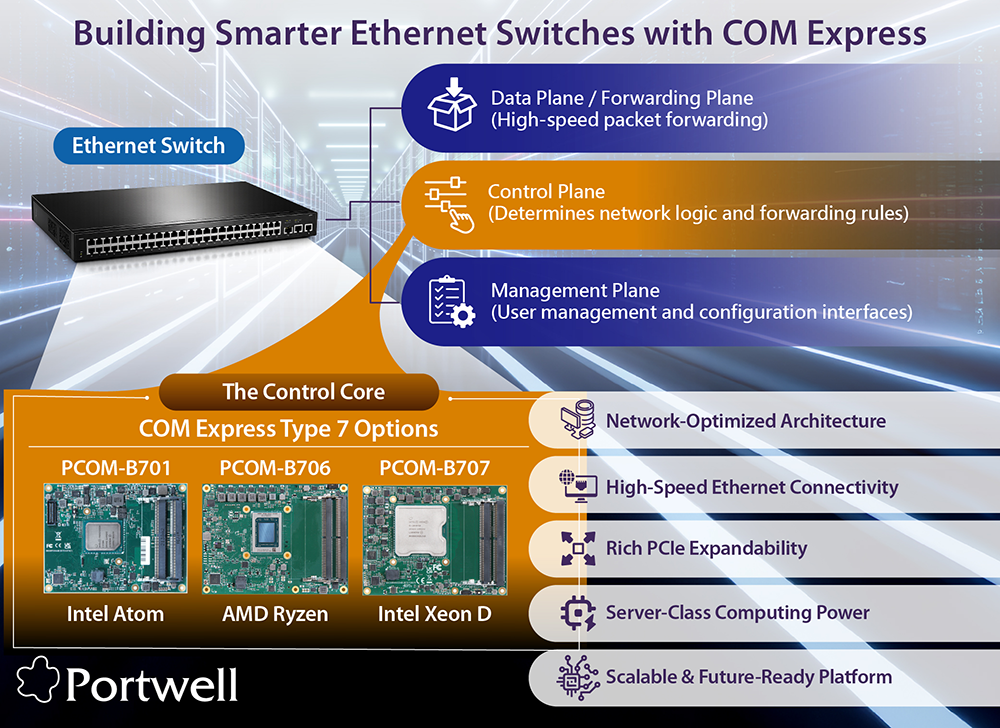
Within a switch architecture, the Data Plane, or Forwarding Plane, is primarily responsible for high-speed packet forwarding, emphasizing low latency, high throughput and wire-speed processing. The Management Plane provides user configuration, monitoring, firmware updates and device management interfaces. The Control Plane, meanwhile, serves as the core that determines network logic, routing rules, forwarding policies and overall system control behavior.
The real challenge lies in enabling the control core to deliver high-performance computing, stable long-term availability, flexible expansion and rapid product iteration at the same time. Although traditional fixed motherboard designs can meet specific product requirements, they often create longer development cycles, higher hardware redesign costs and slower product differentiation when customers need to address multiple switch product tiers, different CPU platforms, varying PCIe expansion requirements and multi-generation product upgrades.
Portwell COM Express Type 7 as the Control Core for Ethernet Switches
Portwell COM Express Type 7 modules can serve as the key computing core for the Control Plane of Ethernet switches, helping customers build more flexible network appliance platforms through a modular architecture. Compared with standard Type 6 modules, COM Express Type 7 is more specifically designed for networking and server-oriented applications. With high-speed Ethernet connectivity and rich PCIe lanes, it enables switch systems to connect with switch ASICs, FPGAs, network acceleration cards, management controllers, storage modules and customized carrier boards.
When the Data Plane relies on switch silicon to handle high-speed packet forwarding, the COM Express Type 7 module can take charge of the system computing tasks required by the Control Plane and Management Plane. These tasks may include routing protocols, switch operating systems, traffic policies, ACL rules, QoS management, telemetry data processing, device health monitoring and remote configuration interfaces.
This architecture allows the Ethernet switch to maintain efficient packet forwarding while also enabling intelligent system management. It also allows customers to select different computing platforms according to product positioning, without the need to redesign the entire motherboard for every product generation.
PCOM-B701, PCOM-B706 and PCOM-B707 Address Multi-Tier Ethernet Switch Requirements
For different Ethernet switch application scenarios, Portwell PCOM-B701, PCOM-B706 and PCOM-B707 provide multi-level options ranging from low-power computing and balanced performance to server-class processing capability.
Diverse Computing Options for Scalable Network Performance
- PCOM-B701, based on the Intel Atom® platform, is suitable for entry-level and mid-range managed switches, industrial network gateways, edge communication devices and control applications that require low-power, long-duration operation. Its value lies in delivering stable Control Plane computing capability, helping customers implement device management, fundamental network protocols and remote maintenance functions under constrained power and space conditions.
- PCOM-B706, based on the AMD Ryzen architecture, is well suited for intelligent switch platforms that require higher CPU performance and stronger multitasking capability. Target applications include industrial automation networks, enterprise edge switches, AIoT gateways and multi-service integration nodes. These applications typically require not only network control, but also data analytics, security monitoring, containerized services or localized management software. As a result, they require a stronger balance between computing performance and power efficiency.
- PCOM-B707, based on the Intel®Xeon D platform, is designed for high-end data center switches, telecom edge equipment, network security appliances and high-density network control platforms. For customers requiring extensive PCIe expansion, high-speed data paths, virtualization environments and server-class reliability, PCOM-B707 can serve as an advanced control core supporting more complex control logic, network services and management workloads. Since PCOM-B707 is powered by Xeon D processor with efficiency bandwidth SFP+ ethernet ports from CPU integrated ethernets. So it can also serve as a unified ethernet control plane, management plane, and data plane architecture because most of users can run the SDN (Software-Defined Networking) and NFV (Network Functions Virtualization) to achieve these functions.
From a system architecture perspective, the modular design of COM Express Type 7 enables the CPU module and carrier board to be designed separately. The carrier board can be customized according to different switch mechanical designs, I/O configurations, power designs, thermal requirements and front-panel port layouts, while the CPU module can be upgraded based on performance requirements.
DMS Services Accelerate Ethernet Switch Development from Design to Mass Production
In addition to COM Express Type 7 modules, Portwell also provides DMS services to help customers complete carrier board design, BIOS and firmware tuning, I/O configuration, thermal design, system validation, mass production and long-term supply management.
For Ethernet switch products, the core value of DMS lies in reducing implementation risks, shortening development timelines and helping customers rapidly transform the network control core into a commercially deployable platform that is ready for mass production, long-term maintenance and future scalability. This further enhances product competitiveness and accelerates time to market.