Amid the rapid surge in global military protection and security demands in 2026, effectively addressing low-altitude drone threats has emerged as a defining battlefield for mission-critical operations. Built on Portwell’s COM Express Type 7 module platform, this solution, developed in collaboration with ecosystem partners, delivers a comprehensive anti-drone defense system for small unmanned aerial vehicles (UAVs). It integrates detection, tracking, and automated countermeasure capabilities, enabling millisecond-level decision response from target acquisition to prioritized threat neutralization, even in the most extreme environments.
COM Express Type 7 Driving High-Performance Anti-Drone Defense Architecture
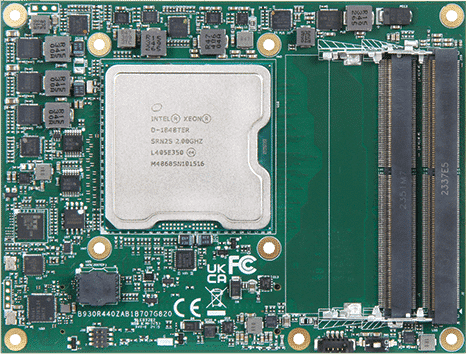
In anti-drone applications that demand intensive data processing and real-time decision-making, the COM Express Type 7 Basic Size module provides a high-performance platform purpose-built for server-grade edge computing. It is ideally suited for high-throughput data streams and multi-sensor integration, delivering the capability to support low-latency data processing and real-time decision execution. Taking Portwell’s PCOM-B707GT as an example, the module is powered by the Intel®Xeon® D-1800 series processor (up to 10 cores), providing a robust and reliable computing foundation for complex Multiple Hypothesis Tracking (MHT) algorithms and trajectory prediction.
In addition, with four 10GBASE-KR high-speed network interfaces, the system ensures that massive data streams from multiple radars and sensors can be transmitted to the command center with near-zero latency, forming a bottleneck-free digital data pipeline. The module also supports a wide operating temperature range of -40°C to 80°C, ensuring stable performance across extreme deployment environments, including desert borders, high-altitude regions, and vehicle-mounted platforms.
High-Bandwidth Edge Processing for Multi-Target Detection
Combining 3D MIMO radar with MHT algorithms, the system achieves high-resolution, continuous tracking. The 10GBASE-KR bandwidth enables real-time processing of large-scale radar data. With Intel®DL Boost acceleration, it delivers precise multi-target detection and accurate 3D positioning in complex environments.
AI-Accelerated RF Analysis for Rapid Threat Identification
In dense RF environments, distinguishing threats must occur within milliseconds. The PCOM-B707GT features a processor with Intel®DL Boost support, enabling accelerated edge AI inference. It allows the system to rapidly analyze multi-dimensional RF features, enhancing signal identification and threat classification efficiency. With up to 64GB DDR4 ECC memory, the system maintains large-scale allowlists and authorization databases, ensuring friendly signals are preserved while threats are prioritized in real time.
Low-Latency C2 with Intel®TCC and Flexible I/O
A web-based Command and Control (C2) system acts as the operational core:
- Real-time situational awareness
- Intel®TCC ensures near-zero latency in radar data visualization.
- Seamless device integration
- Interfaces including USB 3.2, USB 2.0, and UART support cameras, sensors, and HMI devices, enabling flexible deployment.
Millisecond-Level Anti-Drone Response Execution
Integrated with automated jamming systems, the platform supports multi-band disruption across ISM, GSM, LTE, and GNSS:
- High-speed response chain
- 4× 10GBASE-KR ensures rapid command transmission.
- Instant neutralization
- PCIe Gen 4 expansion enables immediate signal execution, achieving fully automated, real-time threat mitigation.
Effective anti-drone systems require high performance, rugged computing platforms. The PCOM-B707GT delivers 10GbE bandwidth, strong processing power, and wide-temperature reliability, making it a critical foundation for real-time threat prioritization and interception in modern defense scenarios.