Machine vision is rapidly evolving from traditional rule-based image inspection into AI-powered visual intelligence. Manufacturers today require systems capable of performing defect detection, object classification, OCR, and barcode reading. These systems must also handle robotic guidance, quality inspection, and predictive maintenance with greater speed and accuracy than ever before. As Industry 4.0 and smart manufacturing continue to mature, deploying an advanced COM-HPC machine vision solution allows production lines to integrate higher-resolution cameras, multi-camera synchronization, and deep learning inference at the edge. This significantly reduces latency while minimizing cloud dependency.
These trends place significantly higher demands on reliable, scalable edge computing solutions, making embedded computing platforms a critical foundation for modern machine vision systems. Modern machine vision systems must handle massive image datasets in real time. They also need to support multiple display outputs and provide high bandwidth for cameras, storage, and AI accelerators. As AI models continue to increase in complexity, equipment manufacturers also require platforms that can be upgraded without redesigning their entire systems. This makes modular computing architectures increasingly important. Beyond raw processing performance, machine vision systems require a balanced combination of computing performance, graphics capability, memory bandwidth, expansion flexibility, and long-term product availability.
AI-powered inspection systems often integrate multiple industrial cameras and GPU processing. Consequently, adopting COM-HPC machine vision modular architecture is ideal to address these requirements. COM-HPC provides extensive PCIe bandwidth, increased memory capacity, USB4 connectivity, and enhanced system scalability. The modular architecture separates the computing core from the carrier board. This allows OEMs and system integrators to upgrade processor generations while preserving existing I/O designs, mechanical layouts, and system certifications. This reduces development cost and shortens product refresh cycles. It also extends equipment lifecycles, which is a key advantage for industrial machine vision platforms that remain in service for many years.
Desktop-Class AI Computing Built for Scalable Machine Vision
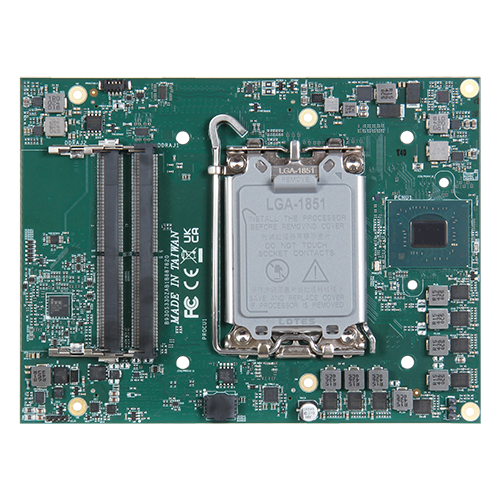
Portwell PCOM-B887 is a COM-HPC Client Type Size C module powered by Intel®Core™ Ultra 200S Series processors. Designed for high-performance embedded AI applications, it combines desktop-class computing with advanced graphics, AI acceleration, and extensive expansion capabilities in a standardized modular platform.
At the heart of the PCOM-B887 is Intel®Core™ Ultra 200S architecture, featuring high-performance CPU cores, an integrated Intel®Xe-LPG GPU, and a dedicated Neural Processing Unit (NPU). The NPU offloads AI inference workloads from the CPU and GPU. This improves overall system responsiveness while delivering better performance per watt for continuous edge AI operation. This heterogeneous computing architecture is particularly beneficial for machine vision applications that simultaneously perform image acquisition, AI inference, data processing, and visualization.
To support demanding imaging workloads, the module provides PCIe Gen5 x16, PCIe Gen5 x4, and additional PCIe Gen4 lanes for integrating frame grabbers, AI accelerators, high-speed networking cards, and NVMe storage. Support for up to 192GB DDR5 memory enables large AI models, high-resolution image buffering, and multi-camera processing. Meanwhile, USB4, USB 3.2 Gen2, SATA, three DDI, and eDP provide extensive connectivity for cameras, industrial peripherals, operator displays, and storage devices.
The integrated Intel®Xe-LPG graphics architecture further enhances machine vision performance through powerful graphics computing and hardware-accelerated AV1 video encoding and decoding. This enables low-latency, high-quality video streaming for remote monitoring, AI inspection, and intelligent video analytics. Together, these capabilities make PCOM-B887 an ideal computing platform for AOI, robotic vision, semiconductor inspection, logistics automation, intelligent surveillance, and AI-enabled quality control systems.
Accelerating AI Vision from Development to Deployment
As AI continues transforming industrial automation, machine vision systems require computing platforms that combine high-performance processing, AI acceleration, scalability, and long-term reliability. Portwell PCOM-B887 brings together Intel®Core™ Ultra 200S Series processors, integrated NPU AI acceleration, PCIe Gen5 expansion, DDR5 memory up to 192GB, USB4 connectivity, and the standardized COM-HPC architecture to meet these evolving requirements.
By adopting PCOM-B887, equipment manufacturers and system integrators can accelerate product development, simplify future processor upgrades, and deploy scalable machine vision platforms. These platforms are fully capable of supporting AI inspection, robotics, industrial automation, and intelligent edge computing. From high-speed vision systems to AI-driven manufacturing environments, PCOM-B887 provides a powerful and future-ready foundation for industrial innovation.