As maritime defense evolves, Unmanned Surface Vessels (USVs) and Maritime Autonomous Surface Ships (MASS) are becoming key platforms linking naval fleets, shore command centers, and distributed systems. They support high risk, long-duration missions such as port security, surveillance, coastal monitoring, and patrol. From an industrial computing perspective, autonomous maritime systems require a distributed edge architecture that connects sensors, communication networks, onboard control, remote command systems, and AI computing resources. At the core of this architecture, a robust maritime edge control platform plays a critical role in sensor data acquisition, mission I/O integration, real-time device control, and data transmission for AI analysis.
By placing low power, scalable edge nodes close to sensors and control equipment, the system can reduce back end server dependency, lower data transmission load, improve response time, and enhance reliability for long duration maritime defense missions.
A Low-Power, Highly Integrated, and Scalable Onboard Edge Control Platform
PCOM-CC01 + PCOM-BC00: A SMARC Development Platform for Accelerating Power Validation and Mass Production Deployment
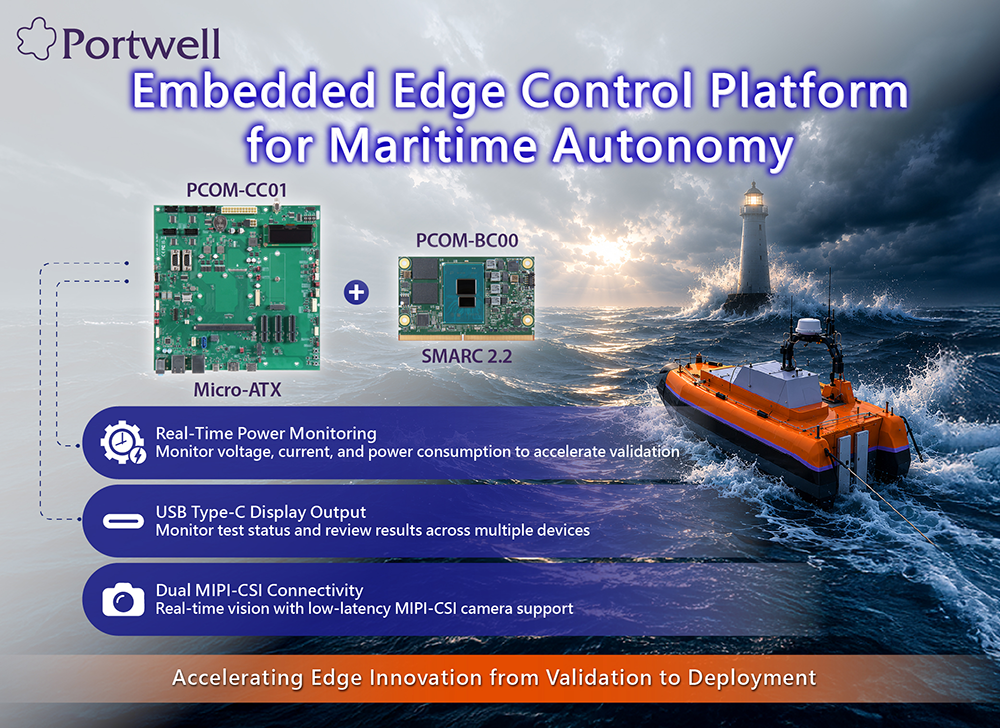
PCOM-BC00 features a compact SMARC 2.2 modular design with a form factor of only 82 x 50 mm. Paired with the PCOM-CC01 Micro-ATX carrier board, it provides a SMARC computing core and development validation platform for rapid prototyping. For USVs and MASS applications, this platform helps developers validate autonomous navigation, sensor integration, and mission data processing. Furthermore, it allows engineering teams to monitor overall system power consumption in real time. PCOM-CC01 supports voltage, current, and power monitoring, enabling engineering teams to evaluate power changes after integrating sensors, communication modules, and mission payloads, reducing the need for additional measurement equipment and repeated testing. With Type-C display output, PCOM-CC01 also improves on-site debugging and validation efficiency. Customers can build a proof of concept with PCOM-BC00 and PCOM-CC01, then evaluate I/O configuration, power design, thermal conditions, and system specifications based on mission requirements, accelerating the transition from development validation to mass production.
High-Speed Networking, Versatile I/O, and Expansion Capabilities for Sensor and Onboard Mission Integration
In maritime operations, USVs and MASS need to integrate diverse data from cameras, radar, AIS, and LiDAR. Consequently, these systems can effectively support autonomous navigation, surveillance, obstacle detection, and mission status reporting. PCOM-CC01 provides dual 2.5GbE interfaces for connecting onboard switches, IP cameras, LiDAR Ethernet modules, radar gateways, and other network-based devices. Dual MIPI-CSI supports low latency imaging for close range vision, docking assistance, and obstacle detection, while USB 3.2 / USB 2.0 enables data acquisition, diagnostics, calibration, and system debugging. With PCIe x1 expansion and M.2 M Key NVMe storage, the platform can support additional networking, image capture, and storage requirements, enhancing flexibility for different mission payloads.
Low Power Consumption, Wide Temperature Support, and Industrial-Grade Stability for Long-Duration Maritime Missions
PCOM-BC00 adopts a low-power SoC architecture and supports different computing levels, including Intel Atom® x7000RE and Intel®Core™ Processor N series options. Therefore, computing performance can be flexibly configured based on onboard mission requirements. With low power consumption ranging from 6W to 15W, the platform is well suited for onboard environments with limited power supplies and enclosed cabins. Consequently, it significantly reduces power load and thermal pressure during long-duration cruising and monitoring missions. Furthermore, selected SKUs support a wide operating temperature range from -40°C to 85°C to address harsh maritime conditions. As a result, this enhances the reliability of USVs and MASS platforms, helping customers build edge control platforms designed for long-term deployment.
Portwell DMS Services: From Prototype Validation to Maritime Mission Deployment
DMS (Design and Manufacturing Services) provides efficient, reliable, and market-oriented support through five core service areas: consulting, product planning, design, manufacturing, and logistics. These services help enterprises reduce deployment risks from technical validation to real-world implementation. Through quality control, BOM management, testing and validation, firmware version control, and supply chain management, the DMS model ensures consistent product quality from pilot production to volume delivery. This enables customers to build long life, maintainable, and scalable onboard edge control platforms, accelerating autonomous maritime applications from technical validation to real mission deployment.