Computed Tomography (CT) and Computed Tomography Angiography (CTA) are key imaging sources in neuroimaging workflows. As image resolution, slice counts, and AI-assisted analysis increase, medical imaging systems must handle more than image acquisition. They also need to support image storage, data transfer, AI processing, and subsequent clinical review.
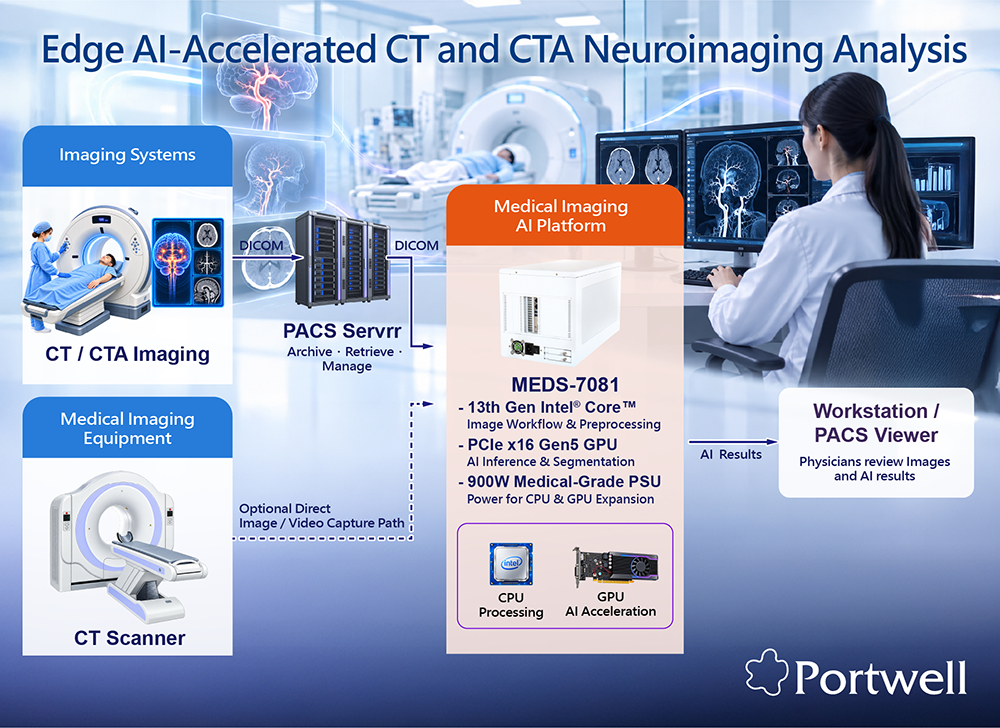
In a typical hospital imaging workflow, CT, CTA, or Magnetic Resonance Imaging (MRI) studies are transferred through Digital Imaging and Communications in Medicine (DICOM) to a Picture Archiving and Communication System (PACS) for centralized storage and management. When AI analysis is required, the relevant studies can be retrieved from PACS and processed by a medical imaging AI platform. The resulting images and AI findings can then be returned to PACS or displayed on a clinical workstation, allowing physicians to review them within their existing imaging environment.
Heterogeneous CPU and GPU Computing for Neuroimaging Analysis
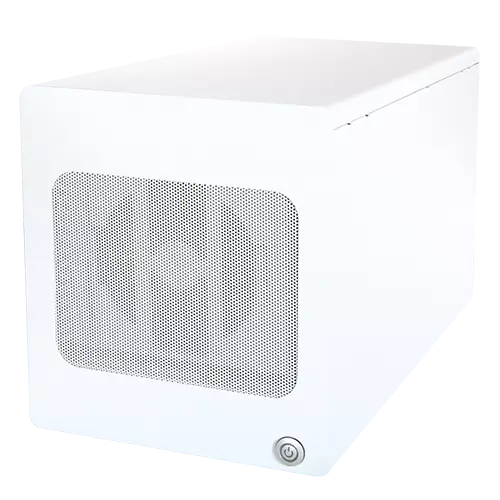
Positioned between PACS and the clinical review environment, MEDS-7081 serves as a medical imaging AI analysis and acceleration platform. Its 13th Gen Intel®Core™ processor handles imaging workflow management, data preprocessing, and application execution. An NVIDIA GeForce RTX™ GPU installed internally through the PCIe x16 Gen5 slot provides parallel computing resources for AI inference, image segmentation, and visualization. The GPU configuration can be selected according to the imaging application and AI workload.
- PCIe x16 Gen5 GPU expansion — Supports internal integration of NVIDIA GeForce RTX™ GPUs for AI inference, image segmentation, and visualization.
- 900W medical-grade power supply — Provides the power capacity required for CPU, GPU, and additional expansion devices.
- Dual GbE connectivity — Supports network integration with PACS and other hospital imaging systems for image transfer and AI processing workflows.
Connecting Medical Imaging Workflows and Diagnostic Workstations
For hospital-based imaging workflows, CT, CTA, or MRI studies can first be managed through PACS and then transferred to MEDS-7081 over dual GbE for further analysis. Applications that require real-time image or video processing can use a separate capture path through PCIe expansion with an appropriate image capture card, keeping direct acquisition separate from the standard PACS-managed workflow.
After processing, medical images and AI analysis results can be presented through a medical imaging workstation or PACS viewer for physician review. MEDS-7081 also provides DP, DVI-D, and HDMI® display interfaces, enabling multi-display medical imaging workstation configurations depending on the system and GPU setup. This allows different image series, anatomical views, or analysis results to be reviewed across multiple displays when required.
Portwell’s Design and Manufacturing Services (DMS) can support the platform with hardware configuration, BIOS and firmware customization, I/O and expansion design, and mechanical and thermal optimization. Support can extend through system validation and production deployment, helping medical equipment developers adapt the computing platform to specific edge AI workloads and medical imaging workflows while maintaining the flexibility needed for system integration and volume production.