CT Imaging Moves Toward AI-Assisted, Data-Driven Clinical Workflows
Computed tomography (CT) remains an essential imaging modality. Healthcare providers rely on it for emergency diagnosis, cancer screening, and treatment follow-up. At the same time, radiology departments face growing imaging volumes while clinical staffing grows more slowly. This gap increases pressure to improve overall workflow efficiency. AI is consequently moving deeper into the medical imaging workflow. The opportunities for AI across the CT imaging workflow include protocol assistance, image-quality assessment, automated processing and other workflow steps. Rather than replacing clinical interpretation, these technologies can provide physicians with additional information and help prioritize relevant findings. As smart healthcare evolves, the challenge expands beyond acquiring high-quality CT images. Hospitals must also process large datasets efficiently and integrate AI results seamlessly into existing workflows.
What CT Applications Require from the Computing Platform?
AI-assisted CT workflows place demanding requirements on the computing infrastructure behind the imaging equipment. First, a CT study moves from the scanner to PACS (Picture Archiving and Communication System) and an AI engine. The AI engine processes the images before delivering analysis results to the physician. Therefore, the computing platform must provide high performance for image reconstruction, visualization, and AI inference. It must also support high-speed data transfer between imaging equipment, storage, displays, and hospital systems. Low-latency local processing can also help reduce dependence on repeated cloud transfers and make AI results available closer to the point of care. Equally important are expansion flexibility for GPU or image acquisition hardware, interoperability with existing imaging infrastructure, and medical-oriented electrical safety and EMC design. As AI becomes part of routine radiology, integration and ongoing quality management are also increasingly important.
MEDS-7081 Brings Performance, Expansion and Medical-Grade Design to CT
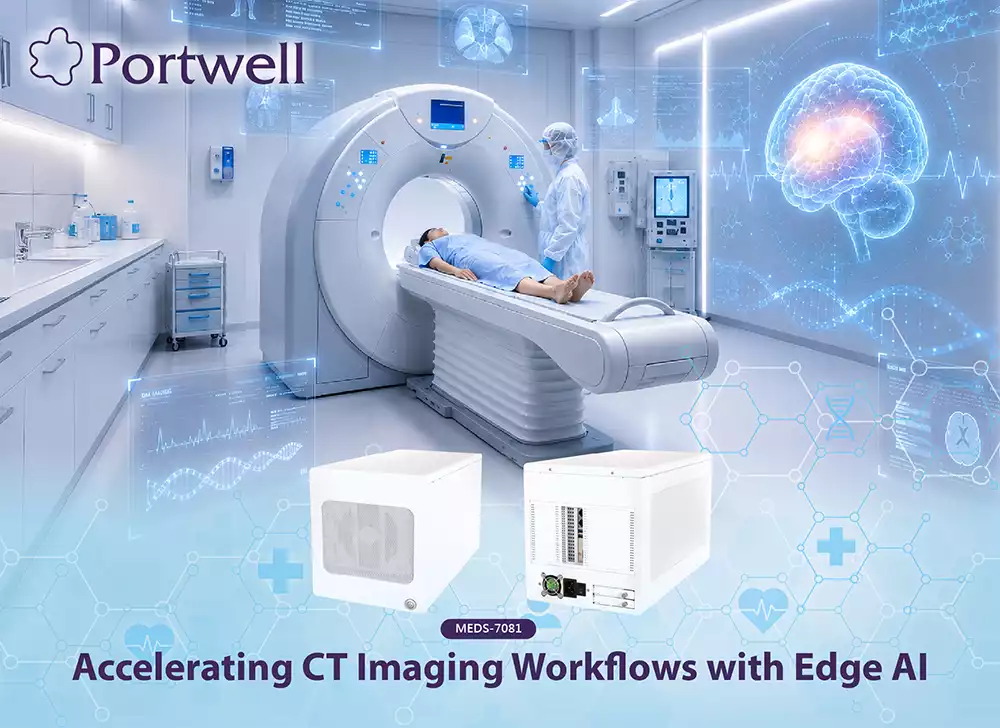
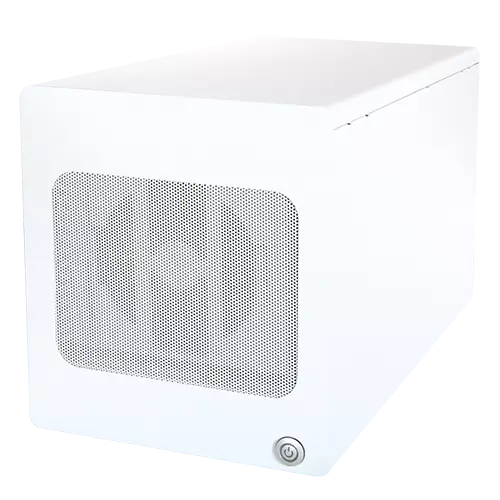
Portwell designed the MEDS-7081 medical computing system to meet these demanding clinical requirements. Powered by 14th/13th/12th Gen Intel®Core™ processors up to 65W, it provides scalable processing for diverse CT and AI workloads. It supports up to 64GB DDR5 memory, M.2 NVMe SSD plus dual SATA storage, enabling fast access to imaging data together with flexible local storage configuration. For advanced AI acceleration, PCIe Gen5 x16 expansion integrates discrete GPUs or custom accelerators. Additional slots accept image acquisition, high-speed networking, or specialty I/O cards. Dual 2.5GbE LAN supports high-speed data exchange with imaging and hospital infrastructure, complemented by USB 3.2 Type-A/Type-C and 4K HDMI® connectivity. In addition, TPM 2.0 ensures hardware security, while a 900W Flex ATX medical power supply meets IEC/EN 60601-1 safety standards.
In an AI-assisted pulmonary nodule screening scenario, healthcare operators transfer CT images directly to MEDS-7081 for local AI analysis. The integrated AI solution identifies potential nodules and highlights their exact locations for physician review. By performing inference close to the CT workflow, the platform can help shorten analysis turnaround time and streamline the path from image acquisition to clinical assessment.
Building a Scalable Foundation for AI-Assisted CT
The role of CT is expanding beyond image acquisition toward a connected workflow combining imaging data, AI-assisted analysis and clinical decision support. Effective imaging AI integration increasingly depends on interoperability among imaging systems, AI applications and clinical workflows, supported by standards-based information exchange. MEDS-7081 provides a flexible hardware foundation for this transition by combining performance, high-bandwidth expansion, local storage, high-speed networking and medical-oriented system design. Equipment manufacturers and solution providers can easily adapt the platform to various performance requirements. It maintains ample room for future system expansion across emerging AI-enabled CT applications. By bringing computing and AI inference closer to medical imaging equipment, Portwell MEDS-7081 helps enable more responsive, integrated and scalable CT workflows for smart healthcare.