AI is becoming increasingly integrated into medical devices and clinical workflows, from medical image acquisition and processing to disease detection, diagnosis, risk assessment, and personalized care. At the same time, medical imaging systems, diagnostic equipment, surgical systems, and patient-monitoring devices are generating increasingly complex data that must be processed with minimal delay. This is driving more computing toward the clinical edge, where data can be analyzed closer to the point of acquisition. On-premises and edge processing can help reduce latency and network dependence while keeping sensitive patient data within healthcare environments. As smart healthcare evolves, medical equipment developers therefore require computing platforms capable of combining general-purpose computing, AI inference, graphics, imaging, and connectivity within compact and streamlined system designs.
Medical AI applications place multiple demands on the computing platform simultaneously. Imaging and diagnostic systems may need to acquire high-resolution data, execute AI inference, process and visualize images, communicate with other equipment, and maintain responsive system operation. Real-time medical edge applications are increasingly combining heterogeneous workloads such as computer vision, physiological signal processing, AI inference, and medical-device telemetry on a single platform.
PCOM-B65B Integrates CPU, GPU and NPU for Medical Edge AI
Computer-on-Module architecture provides medical equipment developers with a practical approach by separating core computing resources from the application-specific carrier board. This allows developers to customize I/O, connectivity, power, and other system interfaces around the requirements of the medical device while maintaining a reusable computing architecture. As AI models and processor generations evolve, a modular design can also provide a more flexible path for platform upgrades and product-family development, particularly for medical equipment with longer development and deployment cycles.
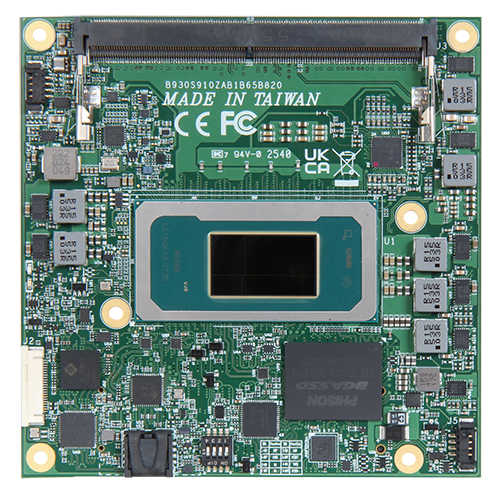
Portwell PCOM-B65B is a COM Express Type 6 Compact (95 x 95 mm) module powered by Intel®Core™ Ultra Series 3 processors. Its heterogeneous architecture combines CPU, integrated graphics, and dedicated AI acceleration on one module. Selected processor configurations provide up to 16 CPU cores, comprising up to 4 Performance-cores, 8 Efficient-cores, and 4 Low Power Efficient-cores, together with Intel®NPU 5 AI accelerator delivering up to 50 TOPS and integrated graphics featuring up to 12 Xe cores and up to 120 TOPS of GPU-based AI performance. This architecture enables workloads to be efficiently distributed across the CPU, GPU, and NPU, making PCOM-B65B well suited to applications such as AI-assisted medical imaging, image enhancement and analysis, ultrasound systems, diagnostic equipment, and other AI-enabled medical devices. By providing integrated AI acceleration, many AI inference workloads can be deployed without an additional accelerator card, potentially simplifying system architecture, expansion requirements, and power design. PCOM-B65B also supports dual-channel DDR5 SO-DIMM up to 128GB at 7200 MT/s with IBECC, PCIe Gen4 expansion, onboard NVMe storage options, 2.5GbE, USB connectivity, display interfaces, and an onboard MIPI-CSI connector. Select SKUs support extended-temperature operation, supporting a wider range of equipment designs and deployment environments.
A Modular Computing Foundation for Smarter Medical Equipment
As medical equipment moves from basic data acquisition toward AI-assisted analysis and real-time decision support, computing platforms must accommodate increasingly diverse workloads without making system design unnecessarily complex. PCOM-B65B combines CPU, GPU and NPU computing, high-speed memory, flexible I/O and COM Express modularity in a compact platform, providing medical equipment manufacturers and solution developers with a scalable foundation for intelligent healthcare systems. Its modular architecture allows application-specific functions to remain on the carrier board while the computing module provides a path for performance scaling and future platform evolution. From medical imaging and ultrasound to AI-assisted diagnostic equipment and intelligent clinical systems, PCOM-B65B brings AI processing closer to the medical data source, helping developers build next-generation healthcare solutions with greater responsiveness, scalability, and intelligence.