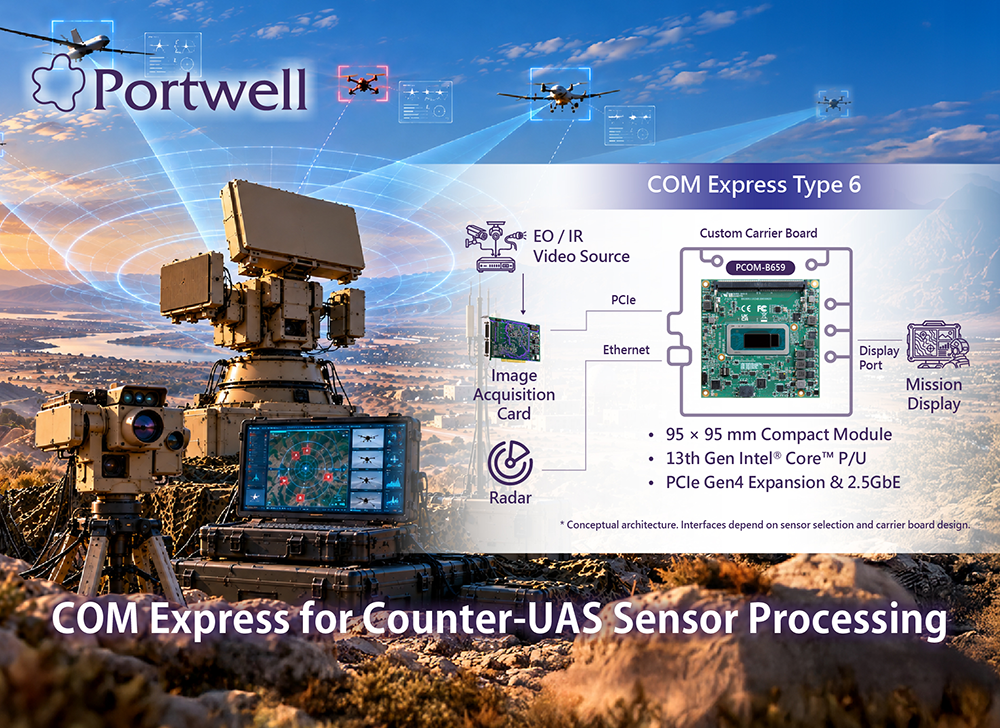
Detection conditions vary by deployment environment, making it difficult for a single sensor to cover every scenario. Radar provides target location data, while electro-optical/infrared (EO/IR) imagery helps operators observe target features. Combining these sources provides a more complete view of the target. As systems incorporate additional sensors, application software must correlate data from different sources and present the results on a monitoring display. On-site computing platforms must therefore handle the processing workload and sensor connectivity within space and thermal constraints. COM Express modules paired with application-specific carrier boards allow computing performance to be selected for the workload, with sensor interfaces tailored through the carrier board. This modular approach helps preserve existing peripheral connections and reduce the need for carrier board redesign during future computing upgrades.
The PCOM-B659 can be evaluated as a sensor data and image processing node in a counter-UAS system. It runs application software for data processing and integrates peripherals through an application-specific carrier board.
The 95 × 95 mm COM Express Type 6 Compact module features 13th Gen Intel®Core™ P/U series processors. DDR5 SO-DIMM memory supports up to 96 GB, allowing capacity to be configured for image buffering and sensor data workloads.
Through a suitable carrier board, 2.5GbE enables internal data exchange or external network communication. Two PCIe Gen4 x4 interfaces support compatible image acquisition cards or high-speed expansion devices. Four USB 3.2 Gen2 interfaces provide connections for compatible sensor peripherals or maintenance equipment.
SATA interfaces and optional onboard NVMe storage can be used with logging software to record sensor data and imagery for later review.
eDP and DDI interfaces can connect displays through a suitable carrier board, allowing application software to present target information, imagery and system status.
Beyond standard COM Express modules, Portwell’s Design and Manufacturing Services (DMS) can support carrier board design and BIOS/firmware requirements for counter-UAS sensor processing platforms. Services also include assistance with testing, validation and production introduction. The separation of the computing module from the application-specific carrier board allows sensor interfaces and display outputs to be configured for project requirements, supporting platform development and ongoing maintenance.
We use cookies to keep this website working, remember your preferences and analyze site usage. Choose which cookies to allow. See our Data Privacy Declaration for details.