

%%PW_PROTECTED_BLOCK_99%%
Machine Vision Banner

Machine Vision: The Key to Driving Industrial Automation

Overview and The Trends of Machine Vision

What is Machine Vision?

Machine vision technology enables industrial equipment to “observe” and make rapid decisions based on visual data. Common applications include defect detection, guidance, dimensional measurement and identification. As one of the foundational technologies of industrial automation, it has long been instrumental in improving product quality, accelerating
production and optimizing manufacturing and logistics processes. Today, this mature technology is integrating with artificial intelligence (AI) and spearheading the transition to Industry 4.0.

A Key Driver of Industrial Automation

Machine vision predates the application of AI, relying on embedded systems and algorithms to process image information and identify basic features. Traditional machine vision applications were relatively simple and required no AI, provided the image data was clear and easily distinguishable. Examples include barcodes and predictable shapes with precise patterns.
With the addition of edge computing and deep learning models, the capabilities and applications of machine vision are rapidly expanding. AI enhances machine vision, extending its role beyond quality control to tasks such as aiding workers in factories, warehouses and transportation systems, allowing them to focus on more value-added tasks.

The Trends of Machine Vision

Growth of Industrial Automation

Growth of Industrial Automation

Increasing adoption across various domains where machine vision systems play a critical role in production, inspection, quality control and process optimization.

Advances in AI

Advances in AI

Expanding usage and enhanced analysis accuracy through AI and deep learning algorithms.

Focus on Quality Assurance

Focus on Quality Assurance

Frequent use in ensuring manufacturing accuracy and defect detection.

Expansion into New Fields

Expansion into New Fields

Applications are growing in agriculture, healthcare, transportation, defense and aerospace.

Future Landscape

Future Landscape

Emphasis on product innovation and differentiation, with vendors expanding ecosystems through mergers, joint ventures and partnerships.

Global Market Size Forecast

Global Market Size Forecast

Given the rapid development and expanding application fields, the global
machine vision market is expected to surpass $30 billion by 2035. The Asia-Pacific region is projected to dominate due to its dense manufacturing infrastructure, with over half of the market share attributed to fully structured machine vision systems used in process control and quality inspection.

Application Fields

Machine vision’s vertical markets include manufacturing, healthcare, logistics and warehousing, transportation, agriculture, defense and aerospace. These industries benefit from efficiency and quality improvements, particularly in manufacturing where defect detection, identification, guidance and dimensional measurement are the most common applications.

Manufacturing Applications and Technical Architecture

Categories in Manufacturing Applications

Defect Detection

Defect Detection

Identifying flaws or quality issues using high-resolution industrial cameras and algorithms to compare real-time production with predefined standards.

Identification

Identification

Recognizing and verifying objects, characters or patterns using Optical Character Recognition (OCR) and barcode scanning.

Guidance

Guidance

Assisting robotic systems in performing precise tasks such as assembly or welding, using 3D cameras and motion control.

Dimensional Measurement

Dimensional Measurement

Ensuring products meet specified tolerances through accurate measurement of size, shape and geometry using high-resolution imaging and algorithms.

Principles of Machine Vision

The process involves four main steps:

The integration of AI improves accuracy and expands the system’s capabilities.

Image Input

Image Input

Acquiring image data through industrial cameras and lights.

Image Processing and Feature Extraction

Image Processing and Feature Extraction

Using image processing to extract key features for subsequent recognition.

Object Recognition and Evaluation

Object Recognition and Evaluation

Applying algorithms to identify objects, text and other elements.

Decision and Output

Decision and Output

Analyzing and acting on the recognition results.

Technical Architecture of Machine Vision

The technical architecture of machine vision is a comprehensive system configuration comprising multiple interconnected key components. The primary components include lights, industrial cameras and software. Additionally, components such as motion control, frame grabber and AI accelerators can be incorporated based on specific application requirements. Each of these components plays a crucial role throughout the process from image capture to decision-making and output.
At the core of the architecture is the industrial PC (IPC) or embedded system which serves as the main control center of the machine vision system. It is responsible for managing and processing overall operations.
The industrial cameras and lights are critical for image acquisition. They are typically connected to the industrial PC via RJ45 or USB interfaces, with their primary function being the capture of high-quality image data.

  • Basic architecture of machine vision system : Light、Camera、Frame Grabber、Software
  • Optional Item : Motion Control、Frame Grabber、AI Accelerator

Lights

A proper light is essential for maximizing contrast and ensuring high-quality image capture. Poor lighting conditions cannot be compensated for even with advanced cameras and software. Common types of light include:

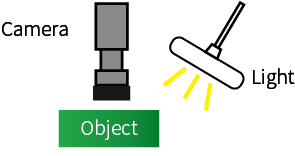
1. Front Lights:

Positioned on the same side as the camera, typically using ring lights, suitable for uniform illumination.

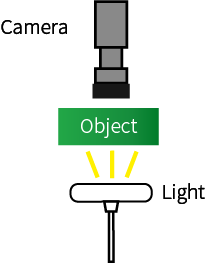
2. Back Lights:

Placed opposite the camera, ideal for measuring object dimensions by creating sharp contrasts.

3. Directed Lights:

Provides highly directional illumination, highlighting textures and creating shadows for better surface analysis.

4. Diffuse Lights:

Delivers soft, even illumination to
eliminate shadows and suppress surface textures.

Front Lights
Machine-Vision Front Lights
Back Lights
Machine-Vision Back Lights

Industrial Cameras

The core of a machine vision system, industrial cameras are categorized by image capture methods:

Area Scan Cameras:

Use pixel arrays to capture an entire image at once, suitable for static or slow-moving objects.

Pros: Easy to use, cost-effective, wide range of applications.

Line Scan Cameras:

Capture one pixel row at a time, reconstructing the complete image in software. Ideal for high-speed conveyor systems.

Pros: Compact size, supports high-speed imaging.

Additional types include:

Smart Cameras :

All-in-one systems integrating cameras, algorithms and software for standalone operation.

Infrared Cameras :

Detect infrared light for unique applications such as low-light environments, smoke detection and thermal analysis.

3D Camera :

Capture depth information using techniques like Time of Flight (ToF) or structured light for applications in robotics and automated inspection.

Hyperspectral Cameras :

Analyze materials based on their spectral characteristics, commonly used in agriculture and material analysis.

Lights

A proper light is essential for maximizing contrast and ensuring high-quality image capture. Poor lighting conditions cannot be compensated for even with advanced cameras and software. Common types of light include:

1. Front Lights:

Positioned on the same side as the camera, typically using ring lights, suitable for uniform illumination.

2. Back Lights:

Placed opposite the camera, ideal for measuring object dimensions by creating sharp contrasts.

3. Directed Lights:

Provides highly directional illumination, highlighting textures and creating shadows for better surface analysis.

4. Diffuse Lights:

Delivers soft, even illumination to
eliminate shadows and suppress surface textures.

Front Lights
Machine-Vision Front Lights
Back Lights
Machine-Vision Back Lights

Industrial Cameras

The core of a machine vision system, industrial cameras are categorized by image capture methods:

Area Scan Cameras:

Use pixel arrays to capture an entire image at once, suitable for static or slow-moving objects.

Pros: Easy to use, cost-effective, wide range of applications.

Line Scan Cameras:

Capture one pixel row at a time, reconstructing the complete image in software. Ideal for high-speed conveyor systems.

Pros: Compact size, supports high-speed imaging.

Additional types include:

Smart Cameras :

All-in-one systems integrating cameras, algorithms and software for standalone operation.

Infrared Cameras :

Detect infrared light for unique applications such as low-light environments, smoke detection and thermal analysis.

3D Camera :

Capture depth information using techniques like Time of Flight (ToF) or structured light for applications in robotics and automated inspection.

Hyperspectral Cameras :

Analyze materials based on their spectral characteristics, commonly used in agriculture and material analysis.

Software

Image Processing

Image Processing

Software processes the image data captured by industrial cameras, converts image formats and extracts critical features for recognition and analysis.

Application Software

Application Software

Based on the extracted image features, application software performs analysis and judgment tasks, such as:

  • Detecting product defects
  • Recognizing human actions
  • Measuring the dimensions of components
Robot Collaboration

Robot Collaboration

Software facilitates robotic applications. Robots act based on decisions made by the application software. For instance, robotic arms can pick semi-finished products deemed defective by the software from the production line and place them in the defective product area.
Software controls hardware devices to execute image processing and analysis. Based on the results, it makes accurate decisions, ultimately enabling automated applications.

AI Accelerators

AI accelerators are hardware devices in machine vision systems responsible for running AI models. Their primary purpose is to enhance the efficiency and accuracy of image recognition and data analysis. In scenarios involving large datasets or complex computations, AI accelerators become critical components of machine vision systems, particularly for tasks such as image recognition and analysis.

Types of AI Accelerator

1. GPU (Graphic Processing Unit),GPUs are divided into two types :

A. GPU Card:

Designed specifically for graphic computations, GPU cards are powerful hardware suitable for AI tasks such as deep learning training, image generation, and natural language processing. Their high computational capacity and fast data transfer speeds make them ideal for handling extensive and complex calculations.

B. GPU SOM (System on Module):

A complete modular system, GPU SOMs are single embedded modules that can be inserted into a carrier board to expand the system’s AI computational capabilities.

2. NPU (Neural-Network Processing Unit) :

NPUs are specialized processors designed to accelerate AI applications. They mimic human neural systems and are energy-efficient, enabling long-term usage. NPUs are suitable for continuous AI computation tasks such as image generation and facial recognition.

3. TPU (Tensor Processing Unit) :

Developed by Google, TPUs are processors designed to accelerate machine learning tasks, particularly for large-scale, low-precision computations.

4. VPU (Vision Processing Unit) :

VPUs are microprocessors tailored for accelerating vision-related tasks. They specialize in executing convolutional neural network (CNN) operations, focusing on single-purpose tasks.

5. ASIC (Application Specific Integrated Circuit) :

ASICs are chips designed for specific and specialized applications, such as cryptocurrency mining, algorithm-based data analysis and inference tasks. These chips are optimized for single-use cases and are not versatile.

6. FPGA (Field Programmable Gate Array) :

FPGAs are programmable logic gate arrays that can be configured to perform complex functions or act as logic gates. They offer flexibility and adaptability, along with low latency and power consumption, making them suitable for diverse edge AI applications.

7. DPU (Data Processing Unit) :

DPUs are designed for network, data security and AI data management tasks. They are ideal for complex data processing tasks in data centers, such as big data, artificial intelligence, machine learning and deep learning.

AI Accelerators

AI accelerators are hardware devices in machine vision systems responsible for running AI models. Their primary purpose is to enhance the efficiency and accuracy of image recognition and data analysis. In scenarios involving large datasets or complex computations, AI accelerators become critical components of machine vision systems, particularly for tasks such as image recognition and analysis.

Types of AI Accelerator

1. GPU (Graphic Processing Unit),GPUs are divided into two types :

A. GPU Card:

Designed specifically for graphic computations, GPU cards are powerful hardware suitable for AI tasks such as deep learning training, image generation, and natural language processing. Their high computational capacity and fast data transfer speeds make them ideal for handling extensive and complex calculations.

B. GPU SOM (System on Module):

A complete modular system, GPU SOMs are single embedded modules that can be inserted into a carrier board to expand the system’s AI computational capabilities.

2. NPU (Neural-Network Processing Unit) :

NPUs are specialized processors designed to accelerate AI applications. They mimic human neural systems and are energy-efficient, enabling long-term usage. NPUs are suitable for continuous AI computation tasks such as image generation and facial recognition.

3. TPU (Tensor Processing Unit) :

Developed by Google, TPUs are processors designed to accelerate machine learning tasks, particularly for large-scale, low-precision computations.

4. VPU (Vision Processing Unit) :

VPUs are microprocessors tailored for accelerating vision-related tasks. They specialize in executing convolutional neural network (CNN) operations, focusing on single-purpose tasks.

5. ASIC (Application Specific Integrated Circuit) :

ASICs are chips designed for specific and specialized applications, such as cryptocurrency mining, algorithm-based data analysis and inference tasks. These chips are optimized for single-use cases and are not versatile.

6. FPGA (Field Programmable Gate Array) :

FPGAs are programmable logic gate arrays that can be configured to perform complex functions or act as logic gates. They offer flexibility and adaptability, along with low latency and power consumption, making them suitable for diverse edge AI applications.

7. DPU (Data Processing Unit) :

DPUs are designed for network, data security and AI data management tasks. They are ideal for complex data processing tasks in data centers, such as big data, artificial intelligence, machine learning and deep learning.

Summary

The applications of machine vision can be categorized into defect detection, guidance, dimensional measurement and identification. Its technical principles consist of steps such as image input, image processing and feature extraction, object recognition and evaluation, decision-making and output.
The primary technical architecture is composed of lights, industrial cameras and software. Depending on the application scenario, additional components such as motion control, frame grabber and AI accelerators can be included. An industrial PC or embedded system serves as the control center of the machine vision system, managing and processing operations.

  • Industrial cameras and lights are used for capturing images.
  • Software controls hardware for image processing, analysis and decision-making.
  • Motion control ensures precise mechanical movements, enabling cameras to capture images from optimal angles.
  • Frame grabber extracts continuous digital frames from analog video signals and transmit them to the machine vision system.
  • AI accelerators execute AI models, improving the efficiency and accuracy of image recognition and data analysis.