Advancing Toward Real-Time Analysis and AI-Assisted Imaging
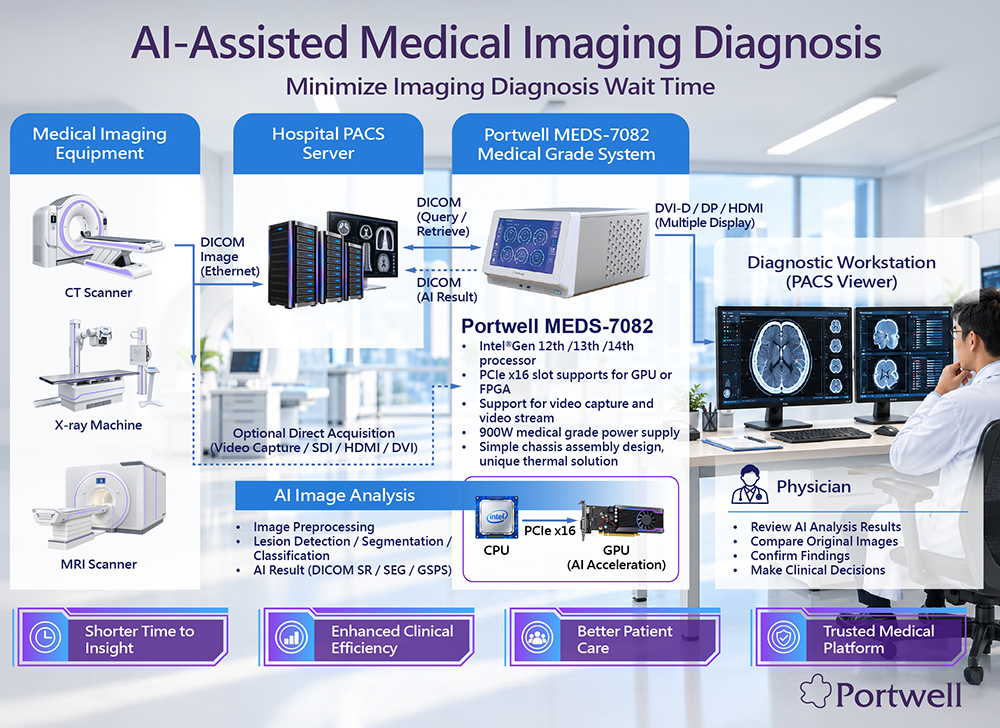
Computed Tomography (CT), X-ray, and Magnetic Resonance Imaging (MRI) have become essential data sources in hospital imaging and diagnostic workflows. As image resolution continues to increase and examination data volumes grow, AI is being progressively introduced into applications such as lesion detection, image segmentation, image classification, and region highlighting. As a result, medical imaging is evolving into a continuous digital workflow that spans image acquisition, data transmission, computational analysis, and result visualization.
Within hospital IT infrastructures, medical images are typically exchanged using Digital Imaging and Communications in Medicine (DICOM) standards and centrally managed through a Picture Archiving and Communication System (PACS).
MEDS-7082 Integrates CPU, GPU, and Medical Imaging Processing
For medical imaging applications of this type, the MEDS-7082 can be deployed between imaging equipment, PACS, AI applications, and physician workstations, serving as an on-premises computing platform for medical image analysis.
The system supports 12th, 13th, and 14th Gen Intel®Core™ processors with up to 65W TDP and up to 64GB DDR5 memory. The CPU can handle operating system tasks, image-processing applications, data management, and AI workflow coordination. For workloads requiring higher levels of parallel computing performance, the PCIe Gen5 x16 expansion slot can accommodate a GPU or FPGA to support AI inference, image segmentation, and other compute-intensive imaging workloads. Additional PCIe Gen3 x4 and x1 expansion slots provide further flexibility for integrating image capture cards or video streaming hardware according to system requirements.
In a typical workflow, images generated by CT, X-ray, or MRI systems can first be stored in PACS, while the MEDS-7082 retrieves the required imaging data over the hospital network for further processing. When integrated with DICOM-compatible applications and AI models, the platform can perform local preprocessing and inference, then deliver candidate lesion regions, segmentation results, or other analytical information to the physician workstation.
The key value of this architecture is to place compute-intensive medical imaging analysis closer to the data source, reducing unnecessary data movement between different computing environments and supporting more efficient integration of AI into existing imaging workflows.
A Scalable Computing Node for Medical Imaging
The capabilities of a medical imaging AI platform depend not only on CPU performance, but also on the overall system architecture. The MEDS-7082 provides two Gigabit Ethernet RJ45 ports that can be configured for PACS connectivity, hospital imaging networks, or system management depending on the project architecture.
For storage, one M.2 Type M 2280 slot and two 2.5-inch SSD bays can be used for the operating system, AI applications, AI models, and temporary image storage. The system also supports USB 3.2 Gen2, USB 3.2 Gen2x2 Type-C, and HDMI® interfaces for connecting operating peripherals, external devices, and displays. Depending on the motherboard configuration, HDMI® output supports resolutions up to 4096 × 2160 at 30Hz.
Power delivery and thermal management are equally important in high-performance medical imaging systems. The MEDS-7082 is equipped with a 900W Flex ATX medical-grade power supply and adopts independent CPU and system thermal designs, providing sufficient power and thermal headroom for the CPU, GPU, expansion cards, and storage devices.
From Computing Platform to Medical Device Productization: Portwell DMS
Medical imaging system development often involves more than selecting a computing platform. GPU and expansion-card compatibility, power configuration, thermal design, mechanical integration, BIOS and firmware customization, system validation, and production management must all be considered during product development.
Through its Design and Manufacturing Services (DMS), Portwell can support customers with system configuration, hardware and mechanical integration, thermal design, compatibility and reliability validation, as well as manufacturing and supply chain management based on application-specific requirements. This enables a standard computing platform to be extended into a medical computing system tailored to individual project needs.
Portwell’s DMS capabilities span design, validation, system integration, and volume production support, helping medical device manufacturers reduce system integration complexity as they move from proof of concept to productization.
Portwell and Wincomm joint showcase at MEDICA 2026
Bringing medical AI computing solutions for real-world healthcare applications. Discover how our flexible platforms can help accelerate innovation from concept to deployment. Visit us at Hall 12, Stand C76, and let’s shape the future of healthcare together.
Explore Our MEDICA 2026 Showcase
Preview featured products for MEDICA 2026 or inquire with our team.