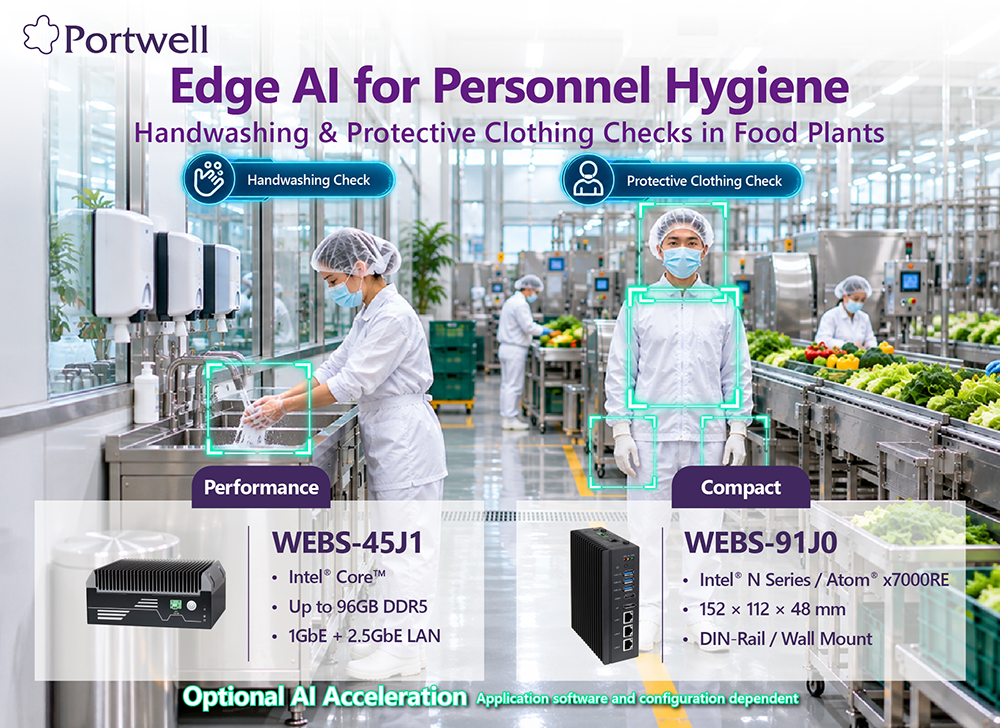
Before entering production areas, food processing personnel must wash their hands and wear the required protective clothing according to plant procedures. As shifts and inspection points increase, checking each worker manually places a greater burden on supervisors. AI-assisted visual monitoring can flag potentially missed steps and prompt workers to correct them on site. Recorded events also help supervisors review issues and follow up.
AI-Assisted Handwashing and Protective Clothing Checks
Cameras capture workers washing their hands and wearing protective clothing for analysis by AI software running on an on-site computing platform. Handwashing checks assess movements and duration against plant standard operating procedures (SOPs). Clothing checks assess whether required items, such as hair coverings and masks, are worn correctly.
WEBS-45J1 for Image Analysis and Multitasking
WEBS-45J1 can be configured to run handwashing and protective clothing checks alongside a monitoring interface and event management software. Its processor and memory options allow resources to be matched to the combined workload.
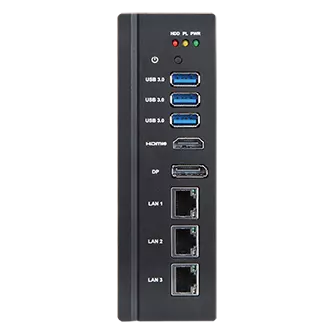
WEBS-91J0 for Space-Constrained Deployment
WEBS-91J0 is an option for installations near handwashing stations or production entrances where enclosure space is limited. Its compact, fanless design simplifies node placement, with processor and AI acceleration configurations selected for the assigned recognition tasks.
WEBS-45J1 offers greater flexibility in computing and memory configurations, while WEBS-91J0 suits installations with limited space. For continuous handwashing and protective clothing analysis, both platforms offer optional AI acceleration modules. These modules can handle compatible model inference, leaving CPU resources available for monitoring and event management.
Integration and Validation for Food Plant AI Monitoring
Through its Design and Manufacturing Service (DMS), Portwell can help select computing platforms and AI module configurations, with integration and validation planned around site requirements. Connecting analysis results to existing alert and recordkeeping workflows can reduce manual checks and documentation, helping supervisors review flagged events and track corrective actions.
We use cookies to keep this website working, remember your preferences and analyze site usage. Choose which cookies to allow. See our Data Privacy Declaration for details.