%%PW_PROTECTED_BLOCK_118%%
Modular computing for commercial UAV systems white paper cover with drone and city skyline

Modular Computing for UAV Systems:

From Ground Control to Onboard AI

Table of Contents

UAV Applications and System Evolution

Modern commercial UAV computing systems have evolved beyond basic flight operations and simple aerial imaging to handle complex mission workloads, high-resolution sensor data, and real-time onboard AI processing. Early applications focused primarily on flight control and post-mission analysis, but current industry demands require advanced edge computing across airborne platforms and ground control stations.

High-resolution cameras enable visual inspection of infrastructure assets, while Electro-Optical/Infrared (EO/IR) systems provide visible-light and thermal imaging for solar panels and broader energy infrastructure. Furthermore, LiDAR supports 3D mapping and structural assessment, while multispectral sensors are used for agricultural and environmental monitoring. As sensor data volumes grow, UAV computing increasingly spans airborne systems, the GCS, and backend infrastructure, placing greater demands on real-time processing and data management.

UAV Mission Data Flow and Ground Control Computing

Mission Data Flow from Airborne Sensors to the GCS

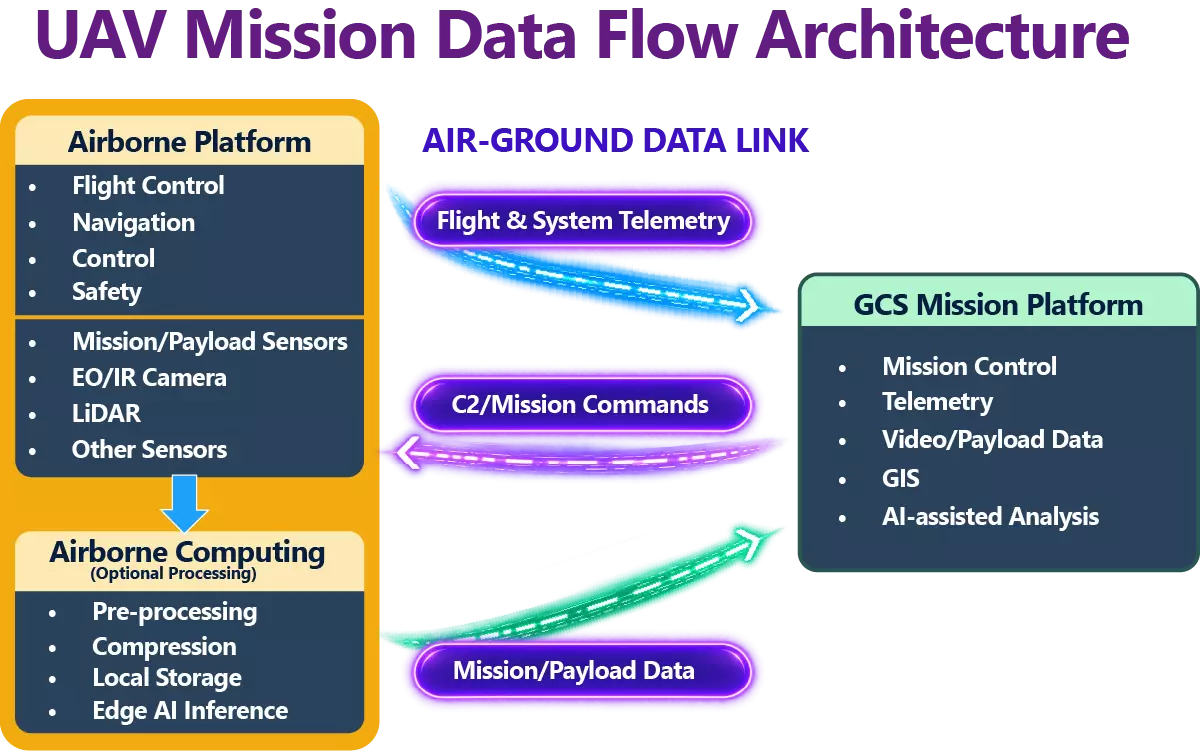
A typical UAV mission data flow consists of the airborne platform, air-ground data link, and ground control station (GCS). The GCS sends Command and Control (C2) instructions for flight, mission, and payload operations, while the UAV returns telemetry on position, speed, attitude, power, and system status. Mission and payload data from onboard sensors may be preprocessed, compressed, or stored before transmission to the GCS. Transmission and processing requirements vary with bandwidth, latency, and data volume.

Workload Distribution and Distributed Computing

UAV workloads are distributed across airborne systems, the GCS, and ground-based backend systems. Airborne systems must operate within tight limits on size, weight, power, and cost (SWaP-C) budgets together with thermal constraints. Processing key data onboard helps reduce transmission needs and enables faster response during flight. The GCS gives operators a central view of the mission, bringing together flight status, live video, map information, and AI-assisted results. Backend systems support large-scale data aggregation, storage, multi-UAV data management, and post-mission analysis, with computing resources scaled according to data volume and operational requirements.

Value of Modular Computing Platforms

Advantages of Computer-on-Module Architecture

Airborne, GCS, and backend systems use similar computing resources, but each is tailored to the tasks it needs to perform. Developing a complete processor board for every product increases design and validation effort and limits future platform reuse. A modular architecture combining a Computer-on-Module (COM) with a custom carrier board provides three key advantages:

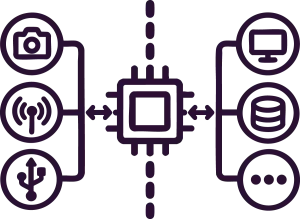
Diagram illustrating COM architecture separating computing core from application-specific carrier board IO
Portwell Logo_only oaoa

Separate the Computing Core from Application-Specific I/O

Processors, memory, and high-speed interfaces reside on the computing module, while application-specific I/O is handled by the carrier board. This reduces board redesign and allows engineers to focus on application-specific functions and system differentiation.

Illustration of carrier board reuse with interchangeable COM modules for system scalability
Portwell Logo_only oaoa

Improve Platform Reuse and Upgrade Flexibility

A common carrier-board design supports computing modules with different performance levels, enabling processor upgrades while reducing redevelopment effort.

Diagram showing simplified product lifecycle management through modular computer-on-module upgrades
Portwell Logo_only oaoa

Simplify Product Lifecycle and Engineering Management

Separating the computing core from the carrier board simplifies processor upgrades, component changes, supply management, and revalidation, reducing long-term maintenance risks.

Selecting Modular Computing Platforms by Deployment Requirements

For airborne systems constrained by size, power, and thermal design, compact platforms such as SMARC and COM Express Type 10 can be considered. Applications requiring greater graphics performance, multimedia processing, and PCIe expansion can use COM Express Type 6. For high-throughput networking and sustained computing workloads, COM Express Type 7 provides additional options, while applications requiring higher compute density, high-bandwidth I/O, or accelerator expansion can consider COM-HPC.

Deployment

Primary Requirements

Workload & I/O Priorities

Platforms Options

Airborne Computing System
  • SWaP-efficient design
  • Thermal management
  • Compact integration
  • Sensor and imaging interfaces
  • Data preprocessing and compression
  • Local storage
  • Low-latency AI inference
  • SMARC
  • COM Express Type 10

(Type 6 depending on performance and expansion requirements)

Ground Control Station
  • CPU and GPU performance
  • High memory capacity
  • Reliable network connectivity
  • Flexible I/O and PCIe expansion
  • Mission control and telemetry
  • GIS and real-time imaging
  • Multi-display support
  • Data storage
  • AI-assisted analysis
  • COM Express Type 6

(Type 10 or COM-HPC depending on size, power, and workload)

Ground Data Processing / Backend Computing
  • Sustained computing performance
  • High data throughput
  • High-capacity memory
  • High-speed networking
  • Multi-source data aggregation
  • Large-scale image processing
  • High-speed data transfer and storage
  • PCIe accelerator expansion
  • COM Express Type 7
  • COM-HPC
Airborne Computing System
Commercial UAV in flight equipped with onboard module for real-time sensor data processing
Primary Requirements
  • SWaP-efficient design
  • Thermal management
  • Compact integration
Workload & I/O Priorities
  • Sensor and imaging interfaces
  • Data preprocessing and compression
  • Local storage
  • Low-latency AI inference
Platforms Options
  • SMARC
  • COM Express Type 10

(Type 6 depending on performance and expansion requirements)

Ground Control Station
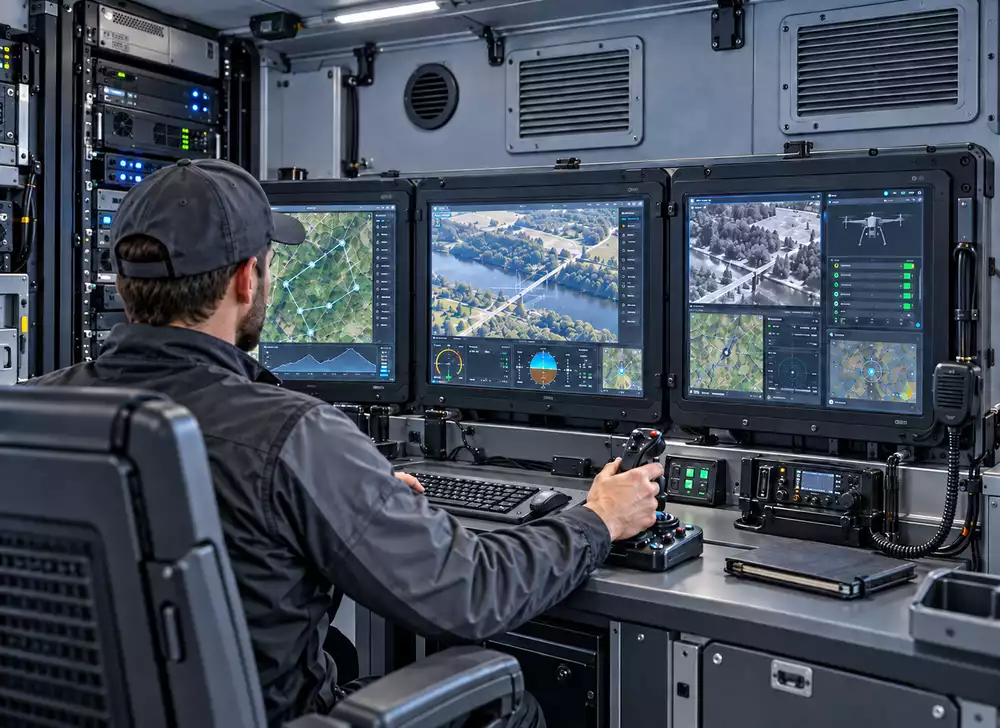
Drone operator using an industrial ground control station with multi-display mission interface
Primary Requirements
  • CPU and GPU performance
  • High memory capacity
  • Reliable network connectivity
  • Flexible I/O and PCIe expansion
Workload & I/O Priorities
  • Mission control and telemetry
  • GIS and real-time imaging
  • Multi-display support
  • Data storage
  • AI-assisted analysis
Platforms Options
  • COM Express Type 6

(Type 10 or COM-HPC depending on size, power, and workload)

Ground Data Processing / Backend Computing
Data center server rack infrastructure for backend UAV data aggregation and analytics
Primary Requirements
  • Sustained computing performance
  • High data throughput
  • High-capacity memory
  • High-speed networking
Workload & I/O Priorities
  • Multi-source data aggregation
  • Large-scale image processing
  • High-speed data transfer and storage
  • PCIe accelerator expansion
Platforms Options
  • COM Express Type 7
  • COM-HPC

(Configurations are for reference. Final selection should be based on system requirements and validation.)

Even within the same deployment category, system requirements vary by form factor and workload. Portable GCS platforms prioritize size, battery runtime, and power consumption, while vehicle-mounted or fixed systems can accommodate greater computing, connectivity, storage, and expansion resources. Backend systems with higher workloads can scale according to data throughput, networking, memory, and accelerator requirements.

Want to explore COM Express architectures, specifications, and platform selection? 

UAV-Based Solar PV Inspection

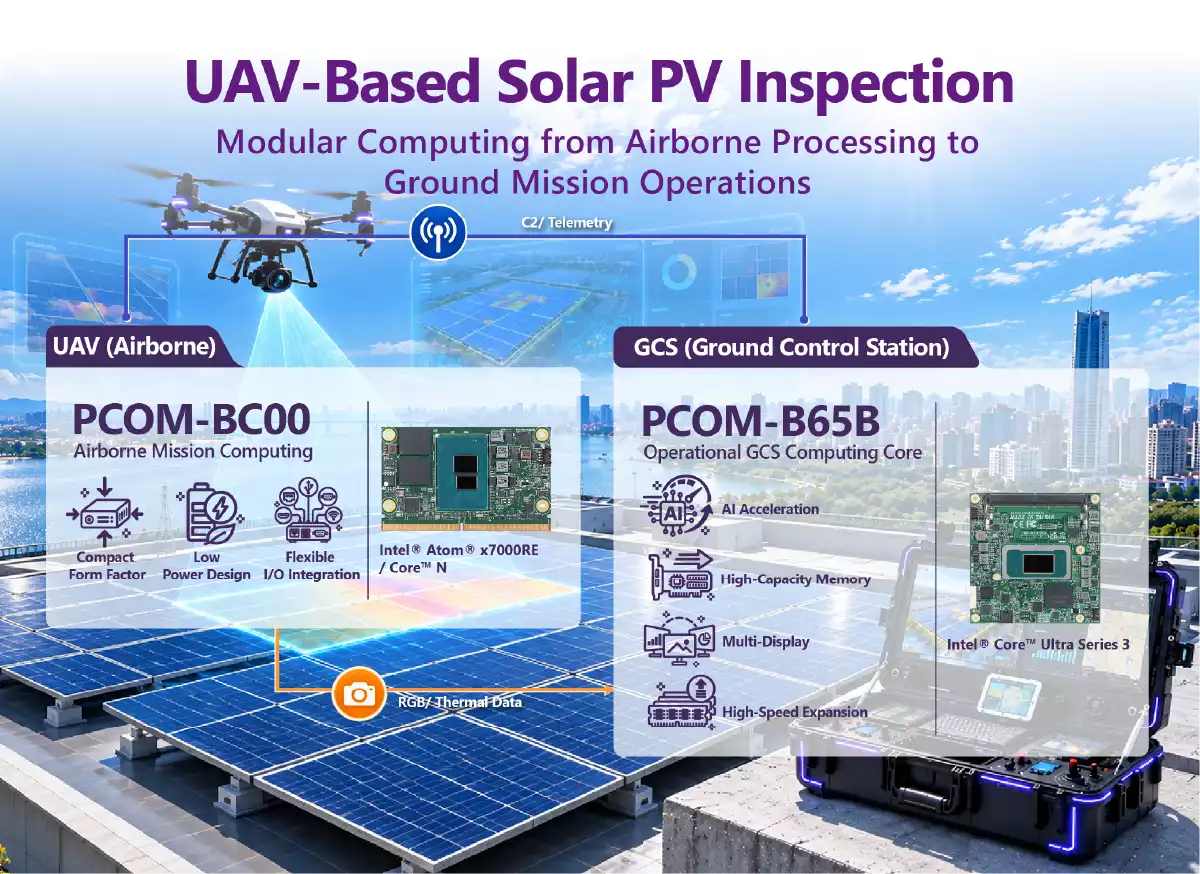
Large solar PV sites can span extensive areas with many modules to inspect. During inspection missions, the airborne system collects flight, visible-light, and thermal data and prepares it for transmission to the ground. At the GCS, operators monitor the mission, review incoming imagery and GIS information, and use AI-assisted analysis to identify potential hotspots before forwarding key data to the backend. This distributed workflow helps reduce network traffic and centralized processing workloads.

Portwell combines computing modules with custom carrier boards for airborne systems and GCS platforms. Its DMS expertise spans BIOS/firmware customization, thermal design, and system validation, supporting OEMs from system development through production to future upgrades.

Portwell Logo_only oaoa

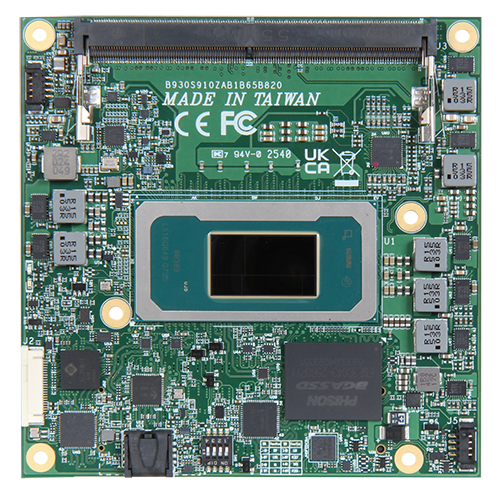
PCOM-BC00: Airborne Mission Computing and Data Preprocessing

Airborne mission computing is highly constrained by SWaP-C and thermal conditions, requiring sufficient imaging, sensor, data link, and storage I/O within limited space and power budgets. To address these constraints, the SMARC 2.2-based PCOM-BC00 measures just 82 × 50 mm and supports processor configurations from 6W to 15W, making it suitable for space- and power-constrained airborne applications. Up to 16GB LPDDR5 memory and 256GB eMMC support image preprocessing, data filtering, and local buffering. USB 3.2, PCIe, UART, GPIO, I²C, and dual 2.5GbE interfaces can be routed through a custom carrier board to integrate cameras, sensors, communication interfaces, and other mission-specific I/O.

Portwell Logo_only oaoa

PCOM-B65B: Core Computing Module for Ground Control Stations

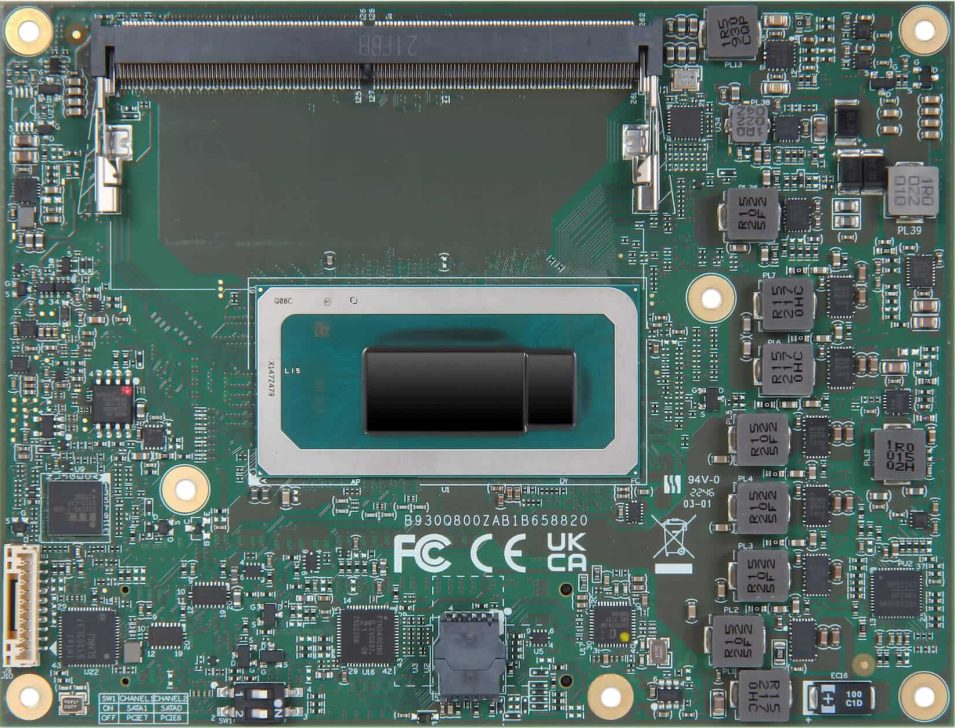
Solar inspection GCS platforms must support telemetry and mission management while handling multi-layer GIS visualization, visible-light and thermal imagery, and real-time AI-assisted analysis. PCOM-B65B combines a COM Express Type 6 Compact architecture with the Intel®Core™ Ultra platform and offers an optional industrial wide-temperature configuration supporting -40°C to 85°C operation. Its heterogeneous computing architecture allows workloads to be distributed across the CPU, GPU, and NPU. The CPU can manage mission and telemetry tasks, the integrated GPU can support GIS and video processing, while the NPU can accelerate supported AI inference workloads through OpenVINO™. With up to 128GB DDR5 and PCIe Gen4 expansion, PCOM-B65B is well suited for integration into outdoor portable GCS computers, balancing computing performance, power consumption, and system expansion requirements.

Portwell offers COM Express Type 6 modules for different GCS deployments:

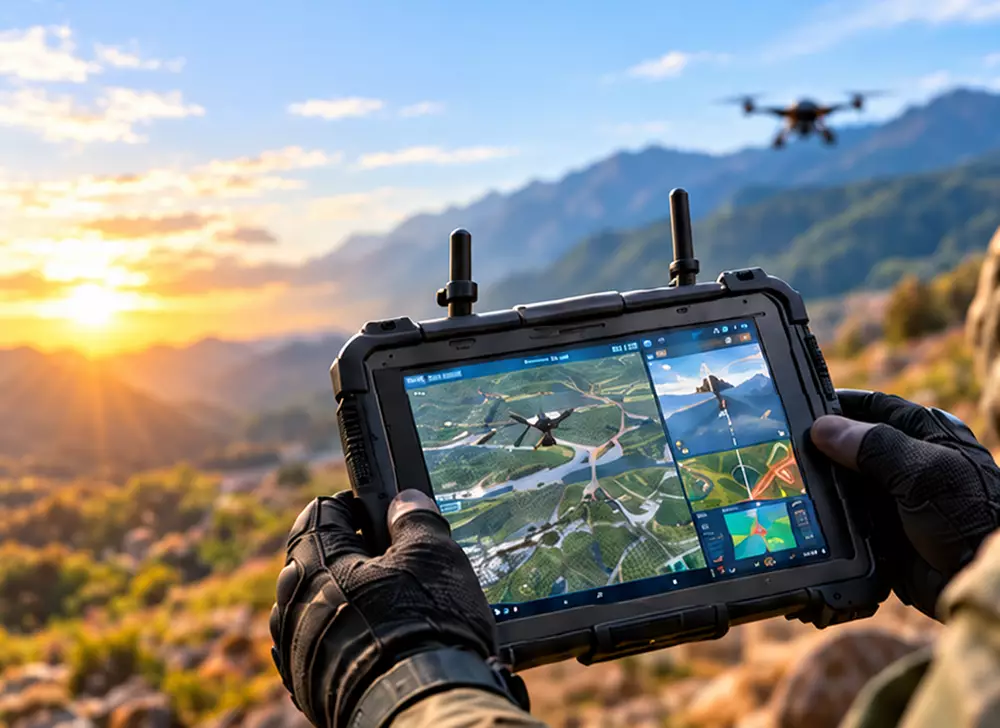
Handheld Tablet GCS
Operator holding a handheld tablet ground control station for drone operation
Recommended Module
PCOM-B646

PCOM-B646

95 × 95 mm
Intel Atom® x7000RE

View Product Details

Advantage

Ultra-low Power:

6W–12W TDP reduces power and thermal demands, while multiple display interfaces support integrated and external displays.

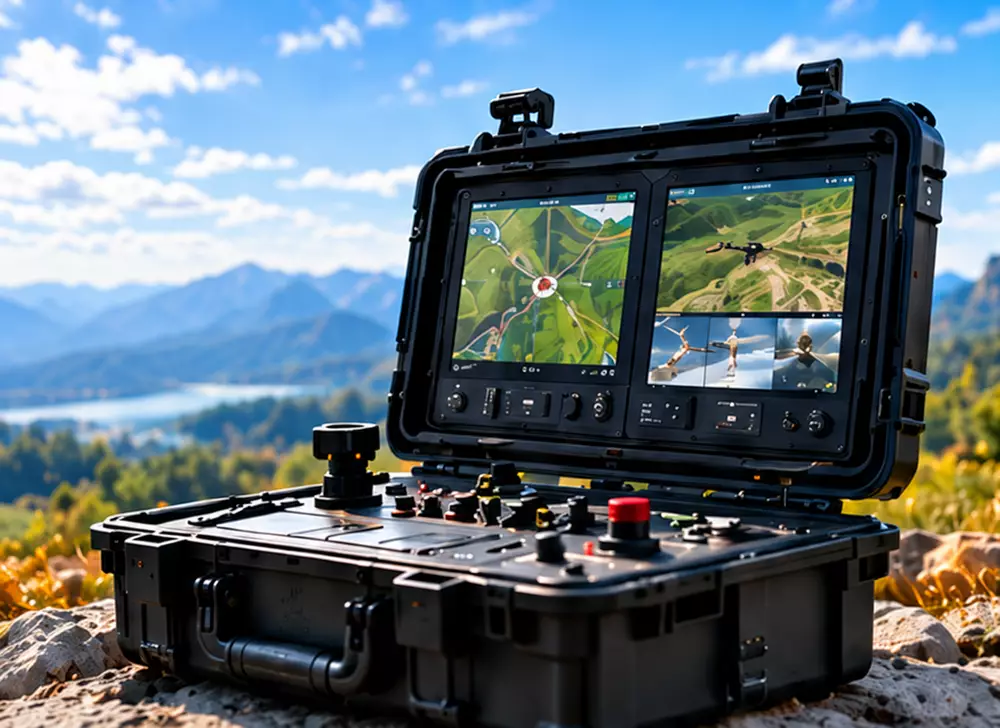
Portable GCS
Rugged portable ground control station with dual displays for drone mission control
Recommended Module
PCOM-B65B

PCOM-B65B

95 × 95 mm
Intel®Core™ Ultra

View Product Details

Advantage

High performance and heterogeneous AI computing:

Integrated graphics supports multi-display GIS rendering, while the NPU accelerates real-time AI image analysis. Supports an optional -40°C to 85°C wide operating temperature range.

Fixed / Vehicle-Mounted GCS
Vehicle-mounted ground control station installed inside a drone mission vehicle
Recommended Module
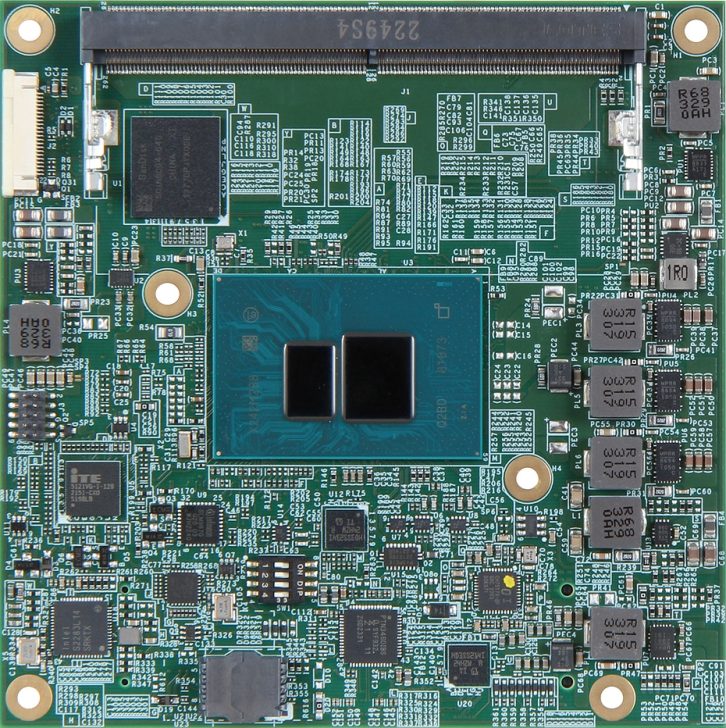
PCOM-B658VGL

PCOM-B658VGL

125 × 95 mm
13th Gen Intel®Core™

View Product Details

Advantage

High expansion and peripheral integration:

Up to 14 cores / 20 threads with multiple PCIe Gen 4 / Gen 3 interfaces for high-speed storage, networking, FPGA/accelerators, and mission peripherals.

As UAV inspection operations scale, backend systems take on more long-term data processing and storage. These workloads place greater emphasis on multicore computing, ECC memory, high-speed networking, and storage expansion. Based on the COM Express Type 7 Basic architecture and Intel®Xeon® D-1800 series processors, PCOM-B707GT provides ECC memory, 10GBASE-KR, PCIe, and NVMe storage for UAV data aggregation, long-term recording, and backend processing.

Portwell DMS Services

Portwell brings extensive experience in industrial PC and embedded computing platform development, with a portfolio spanning SMARC, COM Express Type 6, Type 7, and Type 10. Processor options range from low-power Intel Atom® to Intel®Core™, Intel®Core™ Ultra, and Intel®Xeon® D, allowing computing platforms to be matched to different performance, power, form factor, and lifecycle requirements. Beyond processor performance, UAV platforms also require system-level integration of mission I/O, power, thermal, and mechanical requirements.

Through Design and Manufacturing Services (DMS), Portwell extends its capabilities from computing modules to custom carrier boards, BIOS/firmware, I/O and power integration, thermal design, system validation, and transition to volume production. With a modular computing and custom carrier-board architecture, OEMs and system integrators can retain mission-specific interfaces, connectors, and mechanical designs while adjusting computing resources as product generations and workloads evolve. By combining design, validation, manufacturing, and product lifecycle management, Portwell helps customers transform UAV computing requirements into embedded computing platforms designed for system validation, volume production, and future upgrades.

Subscribe

Press Releases Subscribe Form