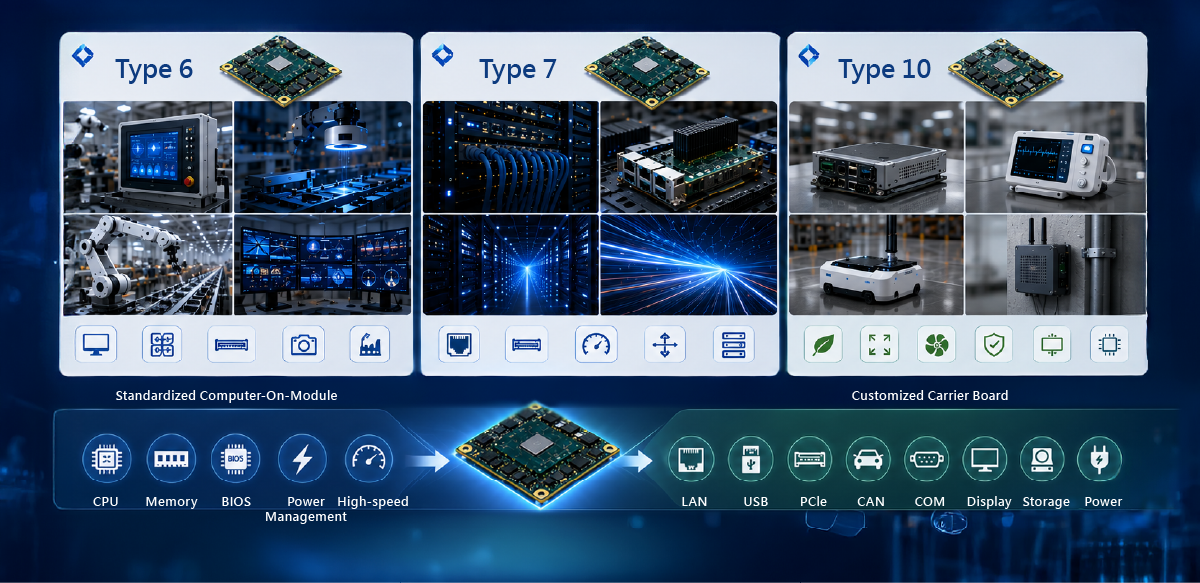
In Part 1 and Part 2 of the COM Express series, we positioned COM Express within the IPC industry from the perspectives of technical specifications and platform strategy. Through the division of labor between a standardized Computer-on-Module and a customized carrier board, COM Express integrates the CPU, memory, BIOS, power management, and high-speed signal interfaces on the module side. Meanwhile, developers design the carrier board around application-specific LAN, USB, PCIe, CAN, COM, display, storage, and power interfaces. Therefore, this enables equipment manufacturers to upgrade the computing core while maintaining the existing mechanical design and I/O architecture. It also reduces repeated design work, validation effort, and supply chain risk.
In terms of form factor and type, Mini, Compact, Basic, and Extended address different space, power, and performance requirements. Specifically, Type 6 is suitable for display, general-purpose I/O, machine vision, and industrial control. Type 7 focuses on high-speed Ethernet, PCIe, and high-throughput applications. Finally, Type 10 is designed for low-power, small-form-factor embedded devices. Compared with SBC, COM-HPC, Qseven, and SMARC, COM Express offers a strong balance of mature ecosystem support and mid- to high-end performance. Furthermore, it provides expansion flexibility and a long product life cycle.
Portwell supports this platform strategy with a product portfolio covering Type 6, Type 7, and Type 10. This is combined with carrier board design, BIOS customization, thermal planning, system validation, and long-term supply support. These capabilities help customers shorten development cycles and build platforms that can be upgraded over time.
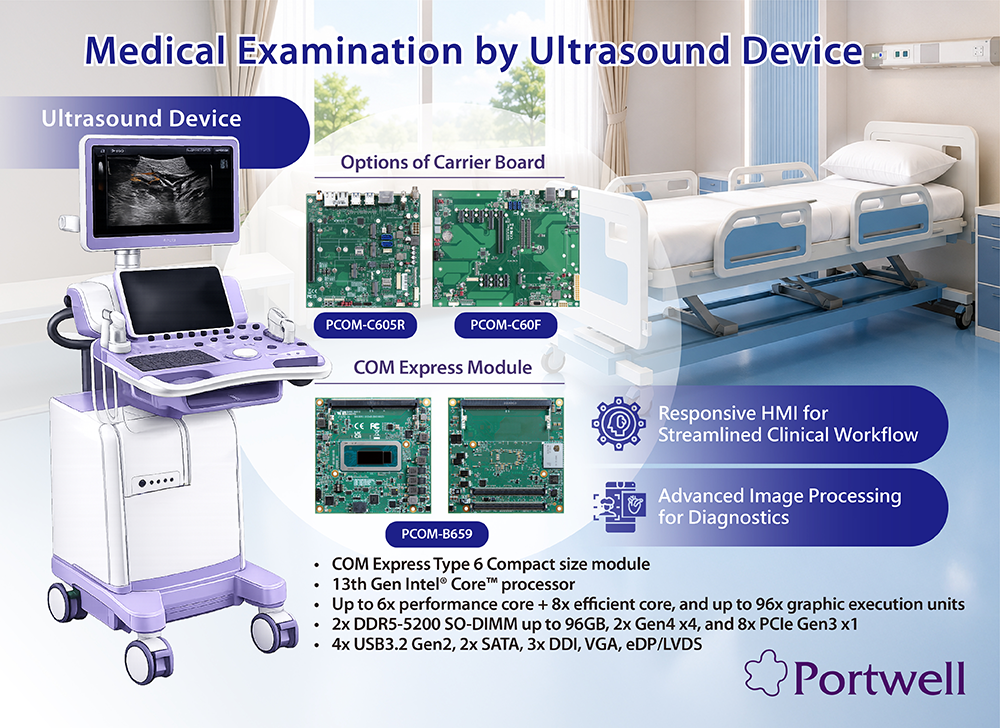
Challenge: Modern ultrasound systems must process high-resolution imaging data and provide responsive graphical interfaces. They must also connect to multiple medical peripherals and operate reliably within limited mechanical and thermal conditions.
Solution: In this application, the PCOM-B659 COM Express Type 6 Compact module serves as the central computing platform for image processing, HMI operation, and system control. Type 6 provides the display interfaces, high-speed storage connectivity, and general-purpose I/O. It also offers the PCIe expansion required to integrate image acquisition devices, signal-processing components, storage, and future acceleration modules.
Benefit: By separating the computing module from the customized carrier board, equipment developers can reuse the same system architecture across different ultrasound product models. Meanwhile, they can adjust peripheral configurations and performance levels. This approach supports faster prototype validation, more efficient product-line development, and easier future computing platform upgrades.
Challenge: Anti-drone systems must simultaneously receive radar and RF sensor data. They also need to perform object tracking, threat classification, and transmit commands with extremely low latency. These workloads require server-class processing, high-bandwidth networking, flexible PCIe expansion, and reliable operation in harsh environments.
Solution: The PCOM-B707GT COM Express Type 7 module provides a suitable edge computing foundation for this architecture. Its high-speed Ethernet resources support multi-sensor data transmission. Meanwhile, its processing and expansion capabilities enable trajectory analysis, AI-assisted RF identification, command-and-control visualization, and automated countermeasure execution.
Benefit: This case illustrates why Type 7 is well suited to applications where display output is secondary. However, data throughput, deterministic response, networking performance, and rugged deployment are critical system requirements.
Challenge: Unmanned aerial, ground, and surface platforms increasingly depend on long-range wireless communication and real-time image transmission. They also require multi-sensor integration and coordinated control between field devices and ground stations.
Solution: The PCOM-B706GT COM Express Type 7 module can function as the core computing and communication aggregation platform. Its high-bandwidth I/O and PCIe expansion resources support integration with 5G NR, long-range wireless modules, and Wi-Fi. It also connects network controllers, image capture devices, AI accelerators, and high-speed storage.
Benefit: The modular architecture allows developers to customize the carrier board for different unmanned platforms. Meanwhile, they can retain common computing, communication, and software assets. This improves design reuse across projects. It also reduces the engineering risk involved in moving from proof-of-concept systems to stable production platforms.
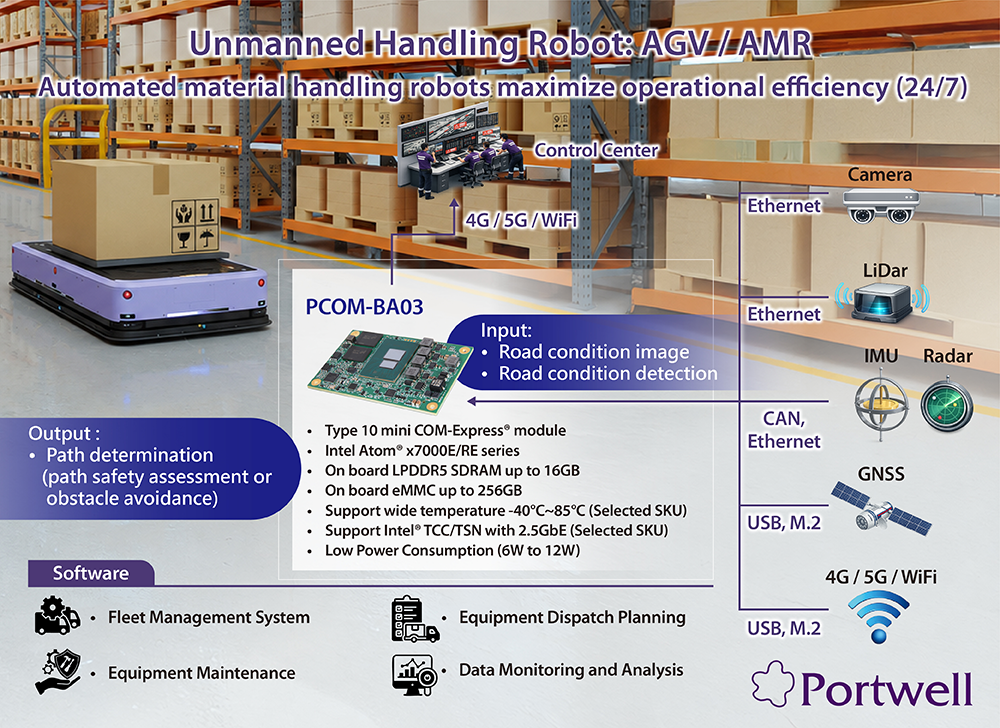
Challenge: AGVs and AMRs operate in dynamic environments. They must continuously process information from cameras, LiDAR, radar, IMUs, positioning devices, and wireless communication modules. Their computing platforms must support real-time path decisions and obstacle avoidance while meeting strict space, power, and thermal constraints.
Solution: The PCOM-BA03 COM Express Type 10 Mini module provides a compact, low-power computing platform for onboard control and sensor integration. Its architecture is designed for applications prioritizing efficient power consumption, small form factor, and reliable operation. In these cases, essential industrial I/O is more important than server-class processing performance.
Benefit: Through customized carrier boards, manufacturers can adapt communication interfaces, sensor connections, storage, and power configurations for different AGV and AMR models. Meanwhile, they preserve a consistent computing platform across product generations.
These cases demonstrate how COM Express modules can be matched to different application workloads. Examples include medical imaging, defense edge computing, unmanned communications, and smart logistics.
Developers can combine a standardized computing module with an application-specific carrier board to reuse core platform designs. This approach accelerates system development and maintains a clearer path for future upgrades.
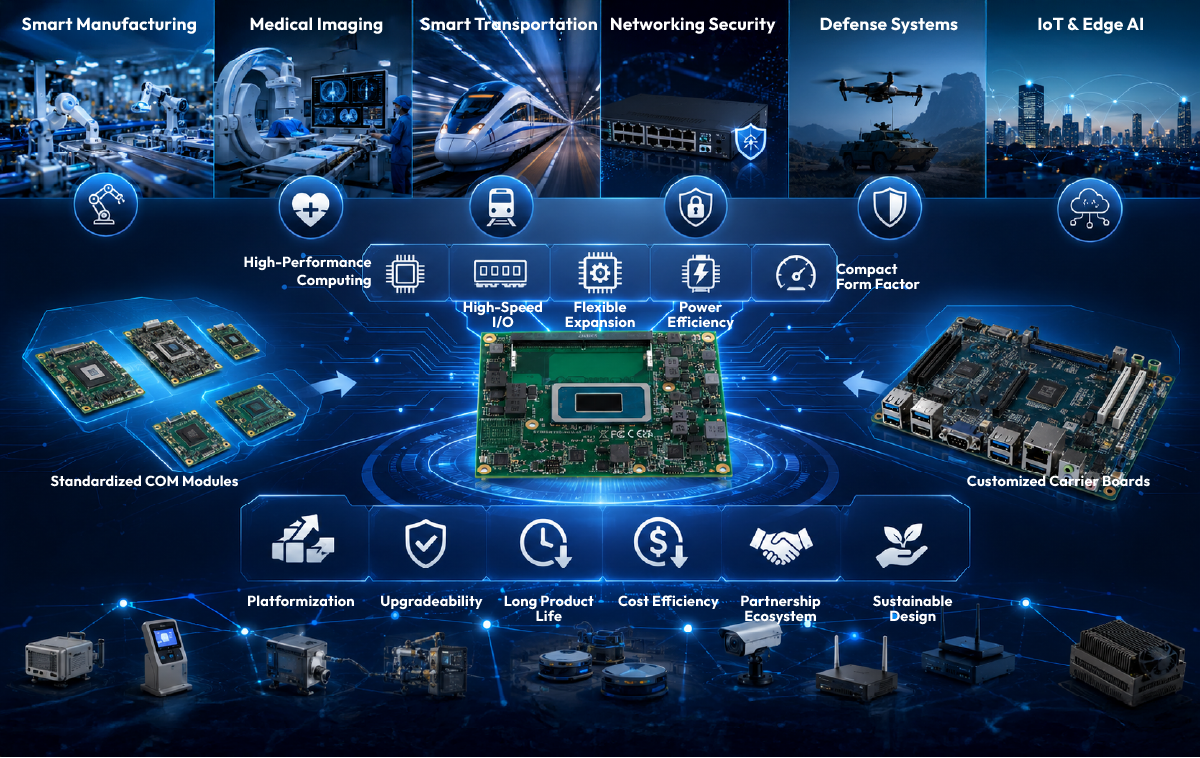
From the perspective of technical positioning, COM Express is more than a compact board specification. It is an important architecture that helps industrial equipment move toward platformization, long product life cycles, and sustainable upgradeability. Across applications such as smart manufacturing, medical imaging, smart transportation, networking security, defense systems, IoT, and Edge AI, end devices must integrate higher-performance computing, high-speed I/O, networking, storage, and diverse sensor interfaces within limited space, power, and thermal conditions. If a complete motherboard must be redesigned every time a processor generation changes or application requirements evolve, development schedules, validation costs, and supply chain risks will increase significantly.
The core value of COM Express lies in separating standardized computing cores from customized application interfaces. The COM module handles the CPU, memory, BIOS, power management, and high-speed signals, while the carrier board is designed around end-application interfaces such as LAN, USB, PCIe, CAN, COM, GPIO, M.2, display, and power. This allows equipment manufacturers to upgrade modules based on different performance, power, and market requirements while maintaining the existing mechanical design and I/O architecture, reducing platform transition risk.
From Type 6 and Type 7 to Type 10, COM Express can address industrial control, machine vision, Edge AI, high-speed networking, edge servers, and low-power embedded devices. Compared with SBCs, it provides greater upgradeability and customization flexibility. Compared with COM-HPC, it offers a more mature industrial deployment foundation and better cost balance. As demand rises for edge AI, high-speed interfaces, heterogeneous computing, and remote management. Therefore, COM Express will continue to serve as an important platform foundation. It helps industrial customers build smart devices that are sustainable, upgradeable, and ready for mass production.

The service value of Portwell DMS (Design & Manufacturing Services) is to extend COM Express from a single module supply model into complete product realization capability. For industrial equipment customers, successful COM Express deployment depends not only on module specifications. It also requires the integration of carrier board design, I/O configuration, power, thermal design, BIOS, firmware, mechanical design, validation, and mass-production maintenance.
Portwell can support customers at the early project stage by helping select the appropriate Type 6, Type 7, or Type 10 module. We also help plan the most suitable platform architecture according to performance, power consumption, form factor, AI acceleration, network bandwidth, and long-term supply requirements.
Through carrier board customization, BIOS/EC tuning, system validation, thermal design, and life-cycle management, Portwell DMS helps customers shorten development cycles and reduce revision risks. It also ensures stable mass-production deployment in healthcare, transportation, defense, networking, industrial control, and smart logistics applications. This makes Portwell not only a hardware supplier, but also a technology partner. We help customers transform innovative applications into reliable industrial systems.